
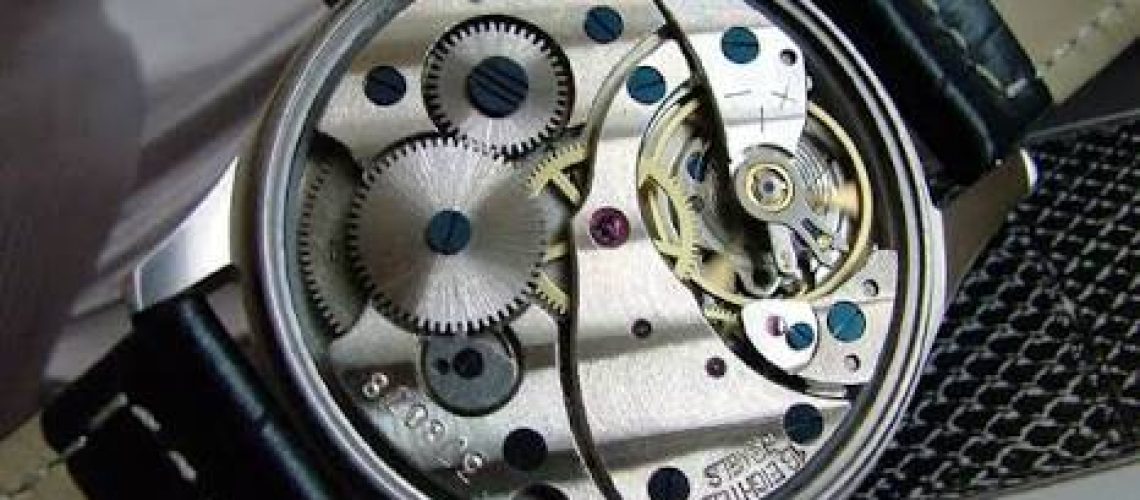

You buy a mechanical watch, set it carefully, and check it the next morning. It is five seconds fast. A week later, it is noticeably ahead. Should you be disappointed? Does it need a service? Or is it performing exactly as intended?
The answer depends on the watch’s published accuracy specification and its measured performance. There is no single acceptable number for every mechanical watch. Rolex publishes a −2/+2 seconds-per-day standard for its Superlative Chronometer watches, while Seiko lists −15/+25 seconds per day for its 6R35 movement under specified conditions. Those are substantially different expectations, and both come directly from the manufacturers.[1][2]
Before deciding that a watch is inaccurate, identify the standard that applies to it. Then measure how it performs during your actual routine.
What Does Mechanical Watch Accuracy Mean?
Mechanical watch accuracy describes how much a watch gains or loses compared with a reference time over a measured period. Manufacturers commonly express that difference in seconds per day.
A watch running at +5 seconds per day gains five seconds over 24 hours. A watch running at −5 seconds per day loses five seconds over the same period. The plus and minus signs describe the direction of the error, not the quality of the watch.
Daily rate and total error are different measurements. If you set a watch correctly and it then gains five seconds every day, it will be 35 seconds ahead after seven days. That does not mean its daily rate has suddenly become +35 seconds.
Here is how a constant rate would accumulate:
|Daily Rate |Error After 7 Days |Error After 30 Days |
|———–|————————-|————————–|
|+2 seconds |14 seconds fast |1 minute fast |
|+5 seconds |35 seconds fast |2 minutes, 30 seconds fast|
|+10 seconds|1 minute, 10 seconds fast|5 minutes fast |
|−5 seconds |35 seconds slow |2 minutes, 30 seconds slow|
These are arithmetic examples, assuming the rate remains constant and the watch continues running without being reset. Your own measurements may vary from day to day.
How Accurate Should a Mechanical Watch Be?
Start with the specification for the exact model and movement. Avoid applying an accuracy range from one watch to every watch bearing the same brand name.
The following manufacturer-published figures provide useful examples:
|Watch or Testing Standard |Published Daily Rate|Context |
|———————————————–|——————–|———————————————————|
|Chronometer movement testing described by Rolex|−4 to +6 seconds |Movement testing before Rolex’s finished-watch assessment|
|Rolex Superlative Chronometer |−2 to +2 seconds |Finished watch, tested after casing |
|Omega Master Chronometer in the cited manual |0 to +5 seconds |Complete-watch certification criteria |
|Seiko 6R35 |−15 to +25 seconds |Specified wrist-wear and temperature conditions |
Rolex distinguishes between testing the movement and testing the completed watch. Omega’s cited Master Chronometer manual also describes separate movement and complete-watch testing. Seiko explicitly notes that conditions of use can affect the actual daily rate.[1][2][3]
The practical implication is straightforward: a watch gaining ten seconds per day could fall inside one movement’s published range while exceeding another watch’s advertised tolerance.
Calling both watches “mechanical” does not make their performance requirements interchangeable.
Why One Day Is Not Enough to Judge Accuracy
An isolated reading can tell you what happened during that period. It cannot establish how the watch performs across your normal week.
Seiko advises evaluating mechanical watch performance using daily rates over roughly a week, rather than relying on a single day. Its instructions also explain that wrist time, movement, position, and winding state can affect the result.[4]
For example, imagine a watch that gains four seconds on the first day, six on the second, and five on the third. Its total gain is 15 seconds over three days, giving an average of +5 seconds per day.
Now imagine another watch that gains 20 seconds on one day and loses 20 the next. Its two-day net error is zero, but those readings deserve more investigation than the average alone suggests.
Keep the individual readings as well as the overall average. A small net error can conceal variation, and a single excellent day does not establish consistently excellent performance.
What Affects Mechanical Watch Accuracy?
Mechanical watches respond to their operating conditions. Understanding those conditions helps you make sense of changes without trying to diagnose the movement yourself.
Position and Temperature
A watch can run differently depending on whether it rests dial up, dial down, or on its side. Seiko explains that gravity affects the movement’s operation and that resting positions can produce different rates. Temperature changes can also influence accuracy through the expansion and contraction of metal components.[5]
For a useful comparison, keep your overnight storage position consistent during the initial test. If you change it later, record that change rather than treating the new result as directly equivalent.
Winding State
Seiko’s mechanical-watch instructions explain that the mainspring’s driving force changes as it unwinds. They recommend regular energy supply through frequent wear for self-winding watches and a consistent winding routine for hand-wound models.[4]
Follow your particular watch’s instructions. Do not assume a winding procedure suitable for one movement is appropriate for another.
Magnetism and Impact
Magnetic exposure can affect mechanical watch timekeeping. Seiko notes that an affected mechanical watch can remain magnetized after it is removed from the source and recommends professional demagnetization. Strong impacts can also affect the small components inside a watch.[5][6]
A sudden change is a reason to seek an assessment. It is not enough information to declare that the watch is magnetized, damaged, or overdue for a complete overhaul.
How to Measure Your Watch’s Accuracy at Home
You do not need to turn ownership into a laboratory exercise. A simple log gives you something concrete to compare with the published specification and discuss with a seller or watchmaker.
1. Find the applicable specification. Check the manufacturer’s instructions for your reference or movement.
2. Choose one reliable reference time. Use the same reference throughout the test, preferably a clock displaying seconds and synchronized to an authoritative time source.
3. Record the starting difference. If the watch starts three seconds fast, write that down. Perfect synchronization is not necessary if you account for the initial offset.
4. Check at the same time each day. Record whether the watch is ahead or behind and by how much.
5. Record relevant conditions. Note winding, wrist time, overnight position, and any interruption in running.
6. Avoid resetting it during the measurement period. If you do reset it or it stops, begin a new measurement period.
7. Calculate the average rate. Subtract the starting offset from the ending offset, then divide by elapsed days.
Suppose the watch starts two seconds fast and ends 37 seconds fast exactly seven days later. It gained 35 seconds during the test, so the average daily rate was +5 seconds.
This method measures the watch’s behavior during your routine. It does not reproduce a manufacturer’s certification protocol, but it provides a clearer starting point than saying, “It seems a little fast.”
What Should You Expect From a Vintage Mechanical Watch?
For a vintage watch, ask about the actual example being sold. Its age, reference, and original certification do not, by themselves, establish its present daily rate.
There is insufficient data to verify a universal acceptable accuracy range for all vintage mechanical watches. A specific expectation needs evidence about that watch and the terms under which it is being offered.
Useful questions include:
● What daily rate was recently measured?
● Was that figure obtained during wear or under a bench-testing procedure?
● How long was the observation period?
● Is there documented service history?
● What timekeeping performance does the seller represent or guarantee?
Distinguish an original specification from a current measurement. A historical certification tells you about a testing standard; a recent observation tells you about the watch’s performance during that observation.
Vintage appeal can justify choosing a watch for its design or history. It does not eliminate the need for a clear description of how the watch currently runs.
When Should You Contact a Watchmaker?
Contact the seller, manufacturer, or a qualified watchmaker when repeated measurements fall outside the applicable tolerance, when performance changes abruptly, or when the watch stops unexpectedly despite being wound according to its instructions.
Provide the measurement log and explain any relevant event, such as a drop or suspected magnetic exposure. Ask what testing is needed before agreeing to a particular repair.
“Runs fast” describes a symptom. It does not establish the cause. Likewise, being within a daily-rate range does not provide a complete assessment of every aspect of the movement’s condition.
Avoid accepting either extreme without evidence: that every small deviation requires major work, or that every large deviation is simply normal because the watch is mechanical.
Questions to Ask Before Buying a Mechanical Watch
Make timekeeping part of the buying conversation if it matters to you. Ask for the applicable specification and clarify whether any quoted rate is a current measurement, a manufacturer’s figure, or a seller’s guarantee.
Those statements have different meanings. “The manufacturer specifies −2/+2 seconds per day” and “this example averaged +2 seconds per day during a recent test” answer different questions. Ideally, you understand both the expected standard and the evidence available for the watch you are considering.
Also decide what level of adjustment you are comfortable with. Using the constant-rate examples above, +2 seconds per day produces one minute of gain in 30 days; +10 produces five minutes. Your tolerance for resetting the time should inform your choice alongside size, style, and condition.
Frequently Asked Questions About Mechanical Watch Accuracy
Is Five Seconds Per Day Good Accuracy?
It can be appropriate, depending on the watch. A gain of five seconds fits the cited Omega Master Chronometer criterion, but exceeds Rolex’s published −2/+2 seconds-per-day range. Check the applicable standard and how the performance was measured.[1][3]
Is Ten Seconds Per Day Normal for an Automatic Watch?
There is no universal automatic-watch tolerance. A gain of ten seconds is inside Seiko’s published 6R35 range, but that does not make it acceptable for every automatic movement.[2]
Should a Mechanical Watch Keep Perfect Time?
Do not assume zero deviation unless a specific claim supports that expectation. The manufacturer examples in this article explicitly allow measurable daily differences.[1][2][3]
Can I Improve Accuracy by Changing Its Overnight Position?
Possibly. Seiko describes testing different resting positions to identify one that offsets gain or loss during wear. Measure your own watch rather than assuming a particular position will always make it faster or slower.[5]
Choose a Watch With Clear Timekeeping Expectations
Mechanical watch accuracy should be judged against a relevant specification, with measurements that reflect how the watch is used. A few seconds of deviation can be consistent with a demanding standard. A larger deviation can fit a different movement’s published range. Neither conclusion should be drawn from price or brand name alone.
When exploring a watch through Tailored Timepieces, ask about the reference, available service documentation, and timekeeping information for the specific example. Clear expectations help you choose a watch whose performance suits the way you want to wear it.