

There are watches you recognize immediately, and there are watches that make you stop and look.
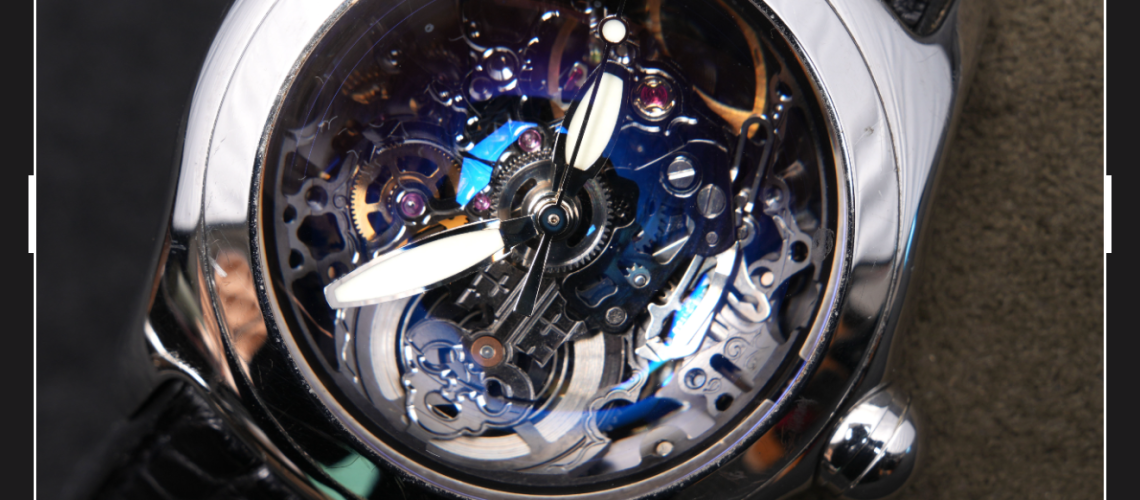
The watch pictured here falls into the second category. Its exposed mechanism, blue accents, sculpted case, and prominent hands give you plenty to study before you even ask who made it.
That visual interest raises a bigger question: where do unusual watches fit in a market where familiar names and recognizable designs make comparisons easier?
Distinctive pieces deserve a place in collecting. They offer personality, mechanical interest, and the pleasure of discovering something outside your usual search. But appreciating an unusual watch and establishing its market value are two different tasks.
Understanding that distinction matters whether you are buying one, selling one, or deciding what belongs in your collection.
What Makes a Watch “Unique”?
In everyday conversation, “unique” often means unusual. Someone might use it to describe an unconventional case, an uncommon dial, or a watch they have never encountered before.
In a sales description, that word needs more precision.
A documented one-of-one watch is different from a limited edition. A limited edition is different from an uncommon variation. And an uncommon variation is different from a standard production watch that happens to be unfamiliar to you.
Those categories can overlap visually while representing very different claims.
For the pictured watch’s exact identity and production status: Insufficient data to verify. The photograph provides a visual example, but it does not establish the manufacturer, reference, case material, originality, or number produced.
You can describe what makes a piece interesting without turning an impression into a production claim.
“An unusual openworked design” describes an observable feature. “The only one ever made” requires evidence.
Rarity Is Only One Part of Desirability
A watch does not become valuable simply because another one is difficult to find.
Scarcity tells you something about availability. It does not tell you how many people want the watch, how strongly they want it, or what they are prepared to pay.
Imagine two hypothetical pieces. One was produced in very small numbers, but few collectors know it exists. The other was made in greater numbers, yet has an established following.
The first has the stronger scarcity story. That alone does not establish which has the stronger market.
Auction specialists also evaluate more than rarity. Sotheby’s collector guidance emphasizes condition, while Phillips discusses condition, rarity, and provenance together as factors in desirability.
The useful question is broader than “How rare is it?”
What is scarce, why does that difference matter, and what evidence shows that collectors value it?
A rare configuration needs a reason to command a premium. The seller’s difficulty finding another example is a starting point for research, not a completed valuation.
The Appeal of Something You Don’t See Every Day
The pictured watch illustrates how a distinctive design can create interest on its own terms.
The exposed components become part of the face of the watch. The blue accents create contrast within the mechanism. The case shape frames that display differently from a conventional round case with a solid dial.
Whether you like those choices is personal. They still give you something concrete to discuss beyond a logo or reference number.
That is an important place for unusual watches in collecting: they create opportunities to develop your own preferences.
You may discover that you care more about case architecture than you expected. You may enjoy seeing the mechanism. You may prefer a watch that invites questions rather than one that people identify across a room.
None of those preferences needs an appreciation forecast to justify it.
The watch still needs to meet your expectations for quality, condition, usability, and price. But its ability to hold your attention is a legitimate part of the purchase.
A Distinctive Watch Can Have a Narrow Audience
A design that strongly appeals to one collector may leave another completely uninterested.
That does not make the design unsuccessful. It does mean that personal enthusiasm should not be mistaken for broad demand.
When assessing a niche piece, I would separate three questions:
- How much do I like it?
- What evidence supports the asking price?
- What evidence suggests I could sell it again on acceptable terms?
Those answers do not have to match.
You can love a watch while acknowledging that its resale market is uncertain. You can recognize excellent work while deciding the price asks too much of you. You can pass on a watch you admire because the ownership questions remain unresolved.
The problem begins when a seller uses emotional appeal to skip those questions.
“You will never see another one” does not explain who will buy it from you later.
Pricing a Watch Without Clear Comparables
An unusual watch can be difficult to price because there may be few relevant transactions to examine.
The response should be a more careful comparison, not a more confident guess.
Start with the exact reference and configuration wherever possible. If completed sales exist, examine what actually sold: condition, documentation, accessories, and any differences from the watch in front of you.
A related model may offer context, but it is not automatically a substitute. A different case material, movement, size, or dial can weaken the comparison.
Asking prices also need to be identified as asking prices. A listing tells you what a seller is seeking. It does not establish that a buyer agreed.
Where evidence is thin, a range may be more honest than a precise number. Where evidence is absent, say so.
For the watch pictured here, there is insufficient information to provide a supported valuation. Assigning a price from this photograph would put speculation ahead of identification.
Documentation Makes the Story Easier to Assess
An unusual watch benefits from a clear explanation of what it is.
Useful supporting material may include manufacturer correspondence, reference information, original paperwork, service records, or documentation of a special commission.
Each document should support a specific claim.
An invoice may help establish a transaction. A service record may help establish work performed. Manufacturer confirmation may help establish a configuration. None should be presented as proving more than it actually does.
Ownership history deserves the same discipline. An interesting story becomes meaningful provenance when the connection can be supported.
Good documentation does not guarantee a particular price. It gives the next person a better basis for evaluating the watch.
That matters especially when the design is unfamiliar and the buyer cannot easily compare it with examples they already know.
Think About Service Before You Buy
A compelling photograph cannot answer the practical questions of ownership.
Before buying an unusual piece, establish who can inspect and service it. Ask about the movement, available support, and any specialized components.
Pay attention to the whole watch. A movement may have a viable service route while a particular crown, crystal, case component, or strap attachment presents a separate question.
Do not assume that a watch is easy to maintain because its movement looks familiar. Do not assume it is impossible to maintain because the brand is unfamiliar, either.
Find the actual answer for the actual piece.
If a service route or replacement component cannot be confirmed, that uncertainty belongs in your buying decision. Attractive design does not resolve an unanswered repair question.
The Dealer’s Perspective: Interest Has to Become a Transaction
From a dealer’s perspective, an unusual watch presents two jobs.
The first is evaluating the watch itself. The second is working out how to explain it accurately to a potential buyer.
That explanation should cover what makes the piece distinctive, what is documented, what remains uncertain, and how the asking price was reached.
A photograph may attract attention. A clear description gives someone a basis for deciding whether to proceed.
There is also a practical difference between admiring inventory and committing money to it. A dealer considering an offer has to assess condition, potential expenses, pricing evidence, and the likely route to a sale.
For that reason, a dealer’s offer and a seller’s hoped-for retail price answer different questions. Neither should be defended with rarity alone.
How to Buy an Unusual Watch With Clear Expectations
Before committing, ask yourself:
- What exactly is the watch, and which details have been verified?
- What makes it distinctive?
- Is its rarity documented, or is it simply difficult to find?
- What supports the price?
- Who can service it?
- Would I still enjoy owning it if resale took longer than I hoped?
That last question is especially useful.
If the entire appeal depends on selling quickly for more money, you are asking the market to validate your purchase. If you enjoy the watch on its own terms, you can assess resale uncertainty more honestly.
Neither enthusiasm nor caution needs to eliminate the other.
Where Unique Pieces Belong
Distinctive watches belong in the market because collectors do not all want the same experience.
Some want familiarity. Others want discovery.
A watch like the one pictured creates an opportunity to look more closely, ask questions, and consider design choices outside the references you already know.
Its place in a collection can begin with that interest. Its place in the market still needs to be supported by identification, condition, documentation, and evidence of demand.
Buy the watch because its differences mean something to you. Pay a premium only when you understand what supports it.