
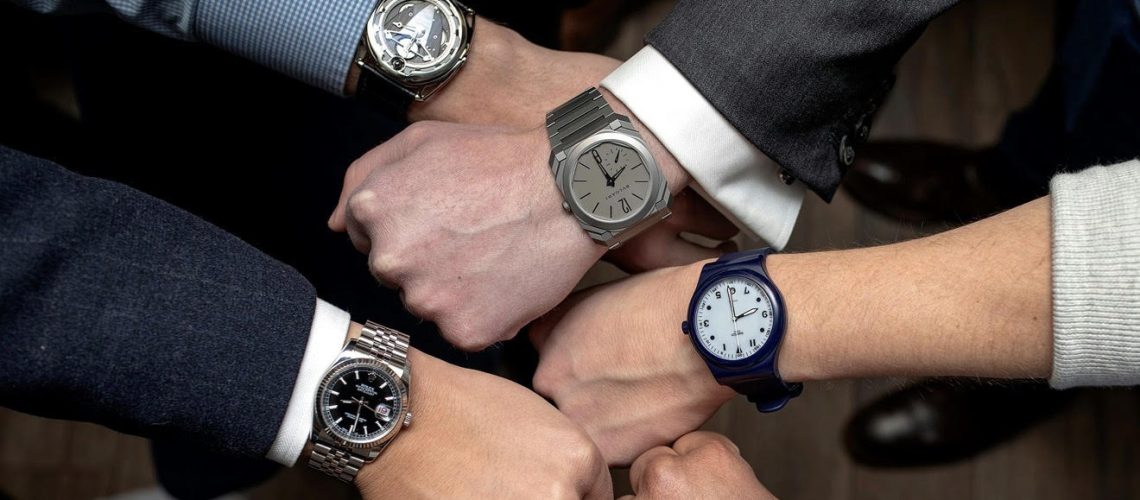

Wearing the same watch every day is rarely an accident. For many men, it is a deliberate choice rooted in psychology, identity formation, habit loops, and decision economics. While modern culture encourages constant novelty—new outfits, new gadgets, new status signals—the daily watch wearer opts out of that cycle. This article examines why wearing the same watch daily is psychologically grounding, how it reinforces identity and discipline, and why this behavior persists among high performers, collectors, and historically influential figures.
This is not a fashion argument. It is a behavioral one.
Why Watches Carry Psychological Weight
A watch is not passive jewelry. It is a tool tied directly to time perception, one of the most psychologically powerful constructs humans interact with daily.
Psychological research consistently shows that objects linked to routine and timekeeping become extensions of self. Unlike phones, which fragment attention, a watch provides controlled access to time without cognitive overload.
Key psychological traits of watches:
- They are persistent (worn daily)
- They are close to the body
- They are linked to accountability
- They operate independently of digital distraction
When worn consistently, a watch becomes a stabilizing object. Over time, the brain associates it with reliability, structure, and continuity.
Habit Formation and the Daily Watch
The Habit Loop
According to behavioral psychology, habits form through a loop:
- Cue
- Routine
- Reward
A daily watch naturally fits this structure.
- Cue: Putting on the watch in the morning
- Routine: Checking time throughout the day
- Reward: Orientation, control, and reduced uncertainty
Because the action is repeated every morning, the watch becomes embedded in subconscious behavior. Removing it can feel disorienting—not because of dependence, but because the brain has anchored part of its daily structure to that object.
This is why many long-term wearers report feeling “off” when they forget their watch.
Identity Reinforcement Through Consistency
Identity Signaling (Internal, Not External)
Most discussions about watches focus on external signaling: status, wealth, taste.
Daily wear operates differently. It reinforces internal identity.
Wearing the same watch daily communicates the following to the self:
- “I am consistent.”
- “I rely on tools, not trends.”
- “I value continuity over novelty.”
Psychologists refer to this as identity-based habit reinforcement. When behavior aligns with self-image, it becomes easier to maintain discipline across unrelated areas: work, fitness, finances.
The watch becomes a silent anchor for that identity.
Decision Fatigue and Why One Watch Wins
Decision fatigue is a well-documented psychological phenomenon. Every choice consumes mental energy. Reducing unnecessary decisions improves focus and performance.
Choosing one watch eliminates:
- Daily accessory decisions
- Status recalibration
- Outfit over-optimization
This mirrors why figures like Steve Jobs reduced wardrobe variation. The daily watch wearer applies the same principle on a smaller, more personal scale.
One watch means:
- No comparison loop
- No second-guessing
- No symbolic clutter
The brain interprets this as control.
Emotional Grounding and Transitional Objects
Psychologists use the term transitional object to describe items that provide emotional regulation through familiarity. While often discussed in childhood development, adults maintain similar relationships with personal objects.
A daily watch functions as:
- A temporal anchor during stress
- A tactile reminder of continuity
- A physical constant during changing environments
This is why watches tied to life phases—first job, inheritance, recovery periods—often become permanent daily wearers.
The emotional value compounds with time.
Masculinity, Utility, and Tool-Based Identity
Historically, men bond with tools before ornaments. Watches occupy a unique position: functional, mechanical, and symbolic.
Daily wear reinforces:
- Utility over decoration
- Maintenance over replacement
- Mastery over novelty
Mechanical watches intensify this effect. The knowledge that a movement requires servicing, regulation, and care mirrors long-term responsibility patterns.
This partially explains why many daily wearers gravitate toward brands known for durability and legibility rather than trend-driven design.
Examples commonly cited by long-term wearers include models from Rolex, Omega, and Tudor—not for hype, but for dependability.
The Psychological Difference Between Rotation and Commitment
Collectors often rotate watches. Daily wearers commit.
Rotation psychology:
- Stimulates novelty-seeking behavior
- Reinforces comparison habits
- Maintains consumer excitement
Daily-wear psychology:
- Reinforces attachment
- Reduces cognitive load
- Builds object-person continuity
Neither is inherently better. But daily wear produces deeper psychological bonding, while rotation favors stimulation.
Notably, many collectors still maintain one watch they default to when focus matters most.
Time Perception and Control
Studies in cognitive psychology show that perceived control over time reduces stress. Watches offer a controlled, glance-based relationship with time, unlike phones, which introduce notifications and competing demands.
Daily watch wearers report:
- Less compulsive time checking
- Fewer phone pickups
- Improved temporal awareness
This creates a feedback loop:
Control → Calm → Consistency
The watch becomes a boundary between the wearer and digital noise.
Scarcity, Patina, and Meaning Accumulation
A daily-worn watch accumulates:
- Scratches
- Patina
- Micro-damage
Psychologically, this matters.
Rather than decreasing value, visible wear increases perceived personal meaning. The object becomes a record of lived time, not preserved potential.
This aligns with the psychological principle of effort justification: the more lived experience embedded in an object, the harder it is to replace.
A pristine watch is replaceable. A worn one is not.
Control in Unstable Environments
During periods of instability—career shifts, personal loss, recovery phases—people gravitate toward constants.
Wearing the same watch daily provides:
- Predictability
- Continuity
- Physical reassurance
This mirrors why military personnel, pilots, and professionals in high-stress environments often standardize their gear.
The watch becomes part of the operating system.
Status Without Performance Anxiety
Interestingly, wearing the same watch daily often reduces status anxiety.
Why:
- No need to “upgrade” daily
- No audience recalibration
- No performative rotation
The signal becomes stable. The wearer is no longer managing impressions—they are reinforcing identity.
This is why understated watches often dominate daily wear, even among those with access to more expensive pieces.
When a Watch Stops Being an Accessory
At a certain point, the watch ceases to feel like something you put on.
It becomes:
- A default state
- A behavioral cue
- A personal constant
Psychologically, this is object integration. The watch becomes part of how the wearer navigates time, not how they decorate themselves.
SEO Keywords Naturally Embedded
Primary keywords used:
- psychology of wearing the same watch
- wearing the same watch daily
- daily watch wearer psychology
- watch and identity
- timepiece habits
- mechanical watch daily wear
Secondary semantic keywords:
- decision fatigue
- habit formation
- identity signaling
- emotional grounding
- time perception
- masculinity and tools
Frequently Asked Questions
Is wearing the same watch every day bad for the watch?
Regular wear increases cosmetic wear but improves mechanical consistency if the watch is properly serviced. Mechanical watches are designed to run continuously.
Why do some people feel anxious without their watch?
This is linked to habit disruption and loss of a time-control anchor, not dependency.
Is rotating watches psychologically unhealthy?
No. Rotation satisfies novelty-seeking tendencies. Daily wear satisfies stability and identity reinforcement.
Why do successful people often wear one watch?
Reducing decisions preserves cognitive bandwidth and reinforces consistent self-image.
Does daily wear increase emotional attachment?
Yes. Repetition and lived experience deepen object-person bonding over time.
Is a daily watch about status?
Internally, no. Externally, it can be—but daily wear is primarily about control, identity, and continuity.
Final Thought
Wearing the same watch daily is not about minimalism, wealth, or tradition. It is about psychological efficiency.
In a world optimized for distraction and novelty, consistency becomes a form of control. The watch is simply the medium.
Time passes either way. Some people choose to feel it grounded on their wrist.