

There are clean deals.
There are complicated deals.
And then there are the trades that perfectly capture where the modern collectibles market is headed.
This year, the wildest trade we accepted was simple in structure but layered in strategy:
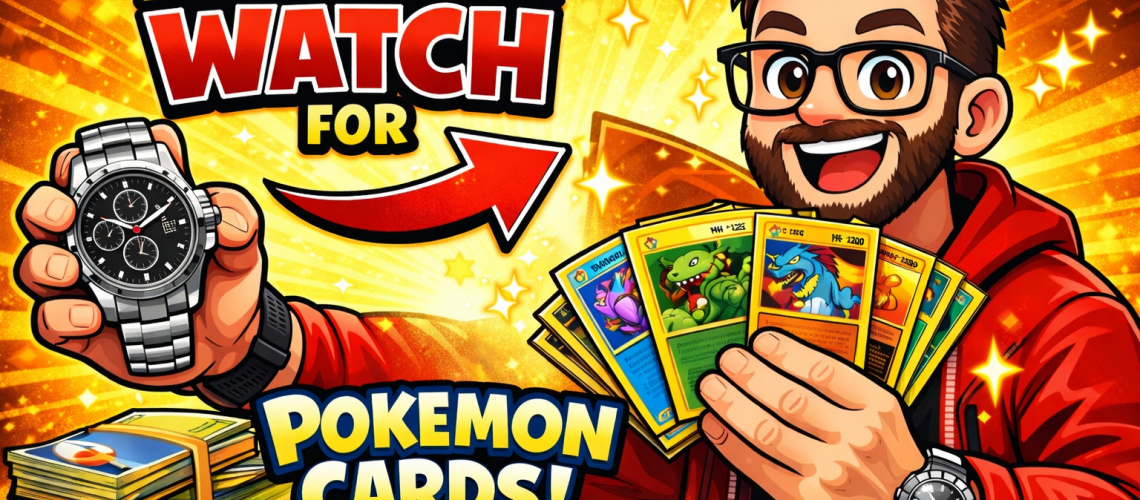
We traded a vintage Rolex 1002 for Pokémon cards.
Not retail for retail.
Not hype for hype.
Not emotion for emotion.
Asset for asset.
Liquidity for liquidity.
Wholesale for wholesale.
This is how it happened — and why it made sense.
The Watch: Rolex 1002 — Quiet, Understated, Classic
The Rolex 1002 is not a hype reference.
It’s not a Submariner.
It’s not a GMT.
It’s not a Daytona.
It’s a 34mm Oyster Perpetual — smooth bezel, automatic movement, understated dial, typically from the 1960s–1980s production era.
Why It Matters
The 1002 represents classic Rolex design language:
- Balanced dial proportions
- Clean stick indices
- No date complication
- Slim case profile
- Everyday wearability
But here’s the reality from a dealer’s perspective:
The 1002 is steady — not explosive.
Market Position
- Entry-level vintage Rolex
- Strong brand recognition
- Modest appreciation curve
- Moderate liquidity
- Highly condition dependent
A great watch.
But capital tied up in a slower-moving SKU is still tied-up capital.
And capital efficiency matters.
The Offer: Pokémon Cards
The client approached with a proposal:
Trade the Rolex 1002 for graded Pokémon cards.
Specifically:
- PSA slabs
- CGC slabs
- Blue-chip characters
- Strong grade tiers
Now, if you’re thinking this sounds unusual — it is.
But it’s not irrational.
The Pokémon Trading Card Game market has matured into a structured collectibles economy:
- Graded population reports
- Auction comps
- Liquidity on eBay and major platforms
- Established grading hierarchy
- International buyer base
This is no longer “kids’ cards.”
This is asset-backed nostalgia with data transparency.
The First Rule: Wholesale-to-Wholesale Math
At Tailored Timepieces, we do not trade retail for retail.
If the Rolex would wholesale at $X, the incoming cards must wholesale at $X or better — with margin built in.
Step 1: Establish Watch Wholesale Value
We evaluated:
- Condition
- Dial originality
- Bracelet configuration
- Service history
- Market comps
- Speed-to-sale expectation
We derived a conservative wholesale number based on realistic dealer exit.
Step 2: Evaluate Card Liquidity
We looked at:
- Grade premium stability
- Population counts
- Recent sold listings
- Market depth
- Time-to-cash
Not “what someone is asking.”
What someone actually paid.
Why the Trade Made Sense
 Liquidity Rotation
A Rolex 1002 may take weeks or months to move at full retail.
Certain PSA 9–10 tier cards can move in days at the right price.
Speed matters.
 Audience Expansion
Our watch audience is one market.
The Pokémon graded card market taps:
- Younger collectors
- International buyers
- High-frequency traders
- Content-driven demand
Diversification reduces dependence on one niche.
 Data Transparency
Vintage watches:
- Condition variance
- Subjective grading
- Service ambiguity
- Dial originality disputes
Graded cards:
- Fixed grade
- Population report
- Encapsulation
- Serial verification
From a volatility perspective, slabs remove interpretive friction.
 Margin Compression Reality
Entry-level vintage Rolex margins have compressed.
More dealers.
More inventory online.
More informed buyers.
Meanwhile, selectively chosen graded cards — when sourced at wholesale — can still produce efficient spreads.
Risk Assessment
Let’s be clear:
This was not a gamble.
It was structured.
Watch Risk
- Slower turnover
- Higher capital lock-up
- Condition-based negotiation pressure
Card Risk
- Grade overexposure
- Character demand cycles
- Modern overproduction risk
We mitigated this by focusing on:
- Recognizable characters
- Strong grades
- Proven liquidity
Emotional vs Strategic Collecting
There is a misconception that trading a Rolex for Pokémon cards is “downgrading.”
That is incorrect.
Collectibles are not ranked by age or material.
They are ranked by:
- Demand
- Liquidity
- Cultural relevance
- Scarcity
- Market participation
The Pokémon TCG market currently commands global attention, auction visibility, and institutional-level tracking.
That matters.
The Bigger Picture: Asset Mobility
What this trade really represents is a shift:
Luxury assets are becoming fluid across categories.
Watch → Card
Card → Watch
Watch → Watch
Card → Cash
Collectors today operate with cross-market awareness.
The traditional silos are dissolving.
What This Says About 2026 Collecting
We are entering an era where:
- Younger collectors prefer graded liquidity
- Capital moves faster
- Nostalgia assets are investable
- Digital visibility drives demand
- Arbitrage exists between verticals
The dealer who understands only watches is narrowing their lane.
The dealer who understands liquidity across asset classes increases optionality.
Execution Details
We structured the trade as follows:
- Agreed on wholesale watch value
- Audited each slab
- Verified certification numbers
- Pulled recent sold comps
- Discounted to dealer exit pricing
- Confirmed margin buffer
- Completed the swap
No emotional decision-making.
No hype premium.
No speculative multipliers.
Just math.
Would We Do It Again?
Yes — under the right conditions.
But not every watch qualifies.
And not every card qualifies.
The criteria:
- Recognized asset
- Verified liquidity
- Wholesale cushion
- Market data support
- Exit plan
Without those, it’s speculation.
With those, it’s strategy.
Final Thoughts
The wildest trade we accepted this year wasn’t wild because it was reckless.
It was wild because it challenged assumptions.
A Rolex 1002 is heritage.
Graded Pokémon cards are modern nostalgia.
Both are cultural artifacts.
Both have global buyers.
Both trade on emotion and scarcity.
But one rotated capital more efficiently in this specific scenario.
And that is the only metric that matters.
If you understand capital flow, liquidity, and market psychology, you understand why this trade wasn’t crazy.
It was disciplined.