

Executive presence is not built on price. It is built on proportion, restraint, and clarity of intent.
In watches, that translates to three things:
- Clean design that reads instantly
- Balanced case sizing and thickness
- Materials and finishing that hold up under scrutiny
An entry-level watch can absolutely project authority if those fundamentals are correct. Below is a structured breakdown of watches that consistently deliver that outcome.
What “Executive Presence” Actually Means in a Watch
Before listing models, define the criteria:
1. Visual Discipline
No unnecessary complications. No clutter. Time-only or simple date is ideal.
2. Case Proportion
Typically 36mm–40mm diameter, under ~11mm thick. Slides under a cuff.
3. Dial Legibility
High contrast. Applied indices or sharp printing. No gimmicks.
4. Material Integrity
Steel done well. Sapphire crystal. Solid bracelet or quality leather.
5. Brand Signaling
Recognizable without being loud. Quiet credibility.
The Core Picks
1. Tissot PRX Quartz
Why it works
- Integrated bracelet design references 1970s luxury sports watches
- Slim quartz profile (~10.4mm) keeps it sharp under a cuff
- Clean dial with strong horizontal texture
Executive signal
You understand design language. You are not chasing logos. You are selecting deliberately.
Best configuration
Blue or silver dial. Avoid overly flashy variants.
2. Seiko Presage Cocktail Time
Why it works
- Automatic movement at an accessible price point
- Textured dials that read refined, not loud
- Classic dress proportions
Executive signal
You value mechanical watchmaking. You respect tradition.
Constraint
Thickness can approach ~12mm. Choose carefully if you wear tight cuffs.
3. Hamilton Jazzmaster Thinline Quartz
Why it works
- Ultra-clean dial execution
- Thin case profile (often under 8mm)
- Swiss brand with real heritage
Executive signal
You prioritize clarity and structure. No excess.
Best use case
Formal settings, client-facing roles, presentations.
4. Orient Bambino Version IV
Why it works
- Domed crystal creates visual depth
- Classic Roman or baton dial options
- Extremely accessible pricing
Executive signal
You understand presentation without overspending.
Constraint
Slightly thicker profile. Works better with relaxed tailoring.
5. Citizen Eco-Drive Corso
Why it works
- Solar-powered reliability (no battery swaps)
- Straightforward design language
- Durable everyday option
Executive signal
You value consistency and function over theatrics.
6. Seiko Essentials SUR Series
Why it works
- Understated to the point of invisibility
- Reliable quartz movement
- Strong value-to-finish ratio
Executive signal
You are not trying to impress. That alone reads as confidence.
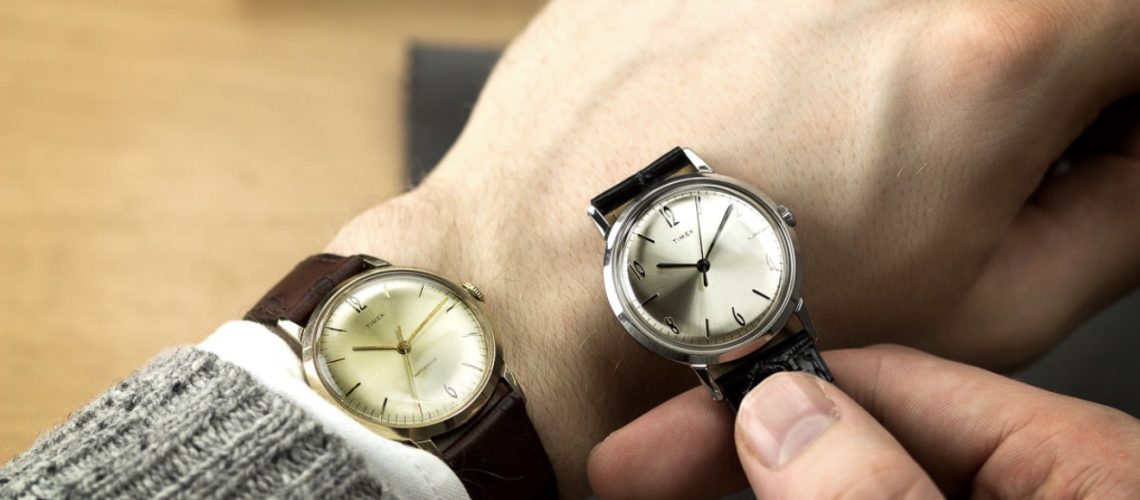
7. Timex Marlin Automatic
Why it works
- Vintage proportions (~40mm or smaller variants)
- Domed acrylic crystal for warmth
- Mechanical option at low entry cost
Executive signal
You appreciate heritage and proportion, even at lower price tiers.
Strap Strategy: The Multiplier
A watch does not operate alone. The strap or bracelet determines how it reads.
For maximum executive presence:
- Black leather → formal, controlled
- Dark brown leather → approachable authority
- Steel bracelet → modern, structured
- Avoid rubber or loud colors in professional settings
A $300 watch on the right strap will outperform a $3,000 watch on the wrong one.
Dial Color Strategy
Color selection is not aesthetic preference. It is signaling.
- White / Silver → clarity, transparency
- Black → authority, control
- Blue → modern professionalism
- Avoid: bright green, orange, skeleton dials for executive environments
Sizing Rules That Cannot Be Ignored
If the watch is too large, everything else fails.
Hard guidelines:
- Wrist under 7 inches → 36mm–38mm
- Wrist 7–7.5 inches → 38mm–40mm
- Lug-to-lug matters more than diameter
- Thickness under 11mm for dress use
Executive presence is proportional. Oversized watches signal inexperience.
Quartz vs Automatic: What Actually Matters
This is often misunderstood.
Quartz advantages:
- Thin
- Accurate
- Low maintenance
Automatic advantages:
- Mechanical interest
- Collector credibility
Reality:
In a professional setting, no one is evaluating your movement type. They are evaluating how the watch looks on you.
What to Avoid Completely
If the goal is executive presence, remove these variables:
- Large chronographs with busy subdials
- Skeletonized dials
- Overly thick dive watches with bright bezels
- Excessive branding or oversized logos
- Fashion watches with poor finishing
These dilute clarity and reduce perceived authority.
How This Translates in Real Scenarios
Client meeting
A slim, clean watch disappears into your overall presentation. That is the goal.
Interview
A simple dress watch communicates preparation and attention to detail.
Daily office wear
Consistency matters more than rotation. One strong watch worn daily builds identity.
The Upgrade Path
These entry-level watches are not endpoints. They are foundations.
The natural progression typically moves toward:
- Better finishing
- Thinner cases
- Stronger brand recognition
Examples at higher tiers include pieces from brands like Longines or Omega, but the design principles remain identical.
If the foundation is correct, the transition is seamless.
Final Position
Executive presence is a constraint-driven outcome.
You are not adding features. You are removing distractions.
A well-selected entry-level watch can:
- Anchor your appearance
- Reinforce discipline
- Signal intention without excess
The price point is irrelevant. The execution is not.
Choose clarity. Choose proportion. Wear it consistently.