
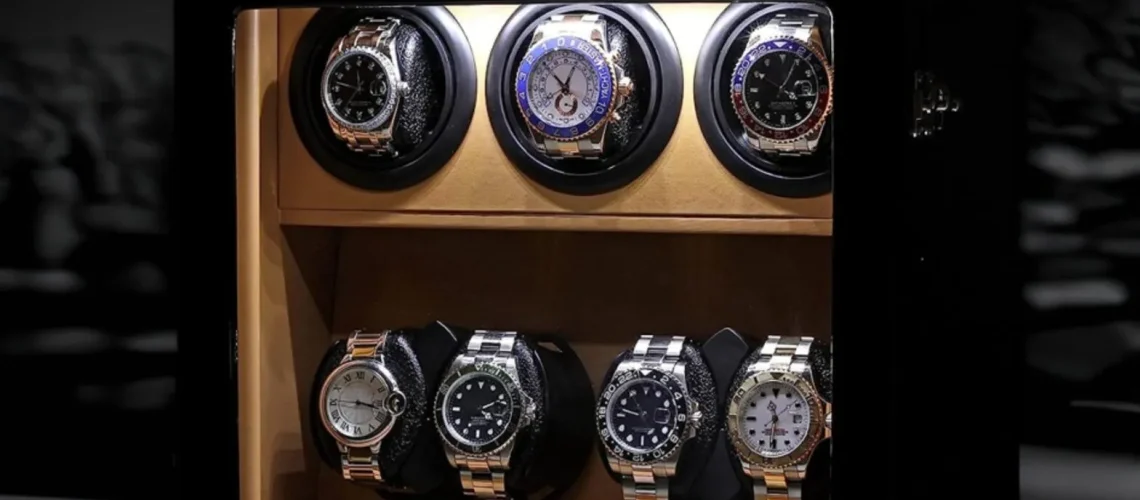

If you own an automatic watch, you have probably wondered whether a watch winder is actually worth buying.
Watch winders are often marketed as essential accessories for serious collectors. They keep automatic watches running while they are off the wrist, can make a collection look more polished, and may save you the trouble of repeatedly resetting complicated watches.
But for many collectors, a watch winder is more of a convenience than a necessity.
So, are watch winders worth it?
The answer depends heavily on the watches you own, how frequently you rotate them, and whether keeping them continuously running provides any real benefit.
What Is a Watch Winder?
A watch winder is a powered device designed to rotate an automatic watch while it is not being worn.
Automatic watches use the movement of the wearer’s wrist to rotate an internal rotor, which winds the mainspring and stores energy.
When an automatic watch sits unused long enough to exhaust its power reserve, it stops.
A watch winder attempts to replicate normal wrist movement by periodically rotating the watch, helping maintain its power reserve.
Most modern automatic watches can simply be restarted and reset when you decide to wear them again.
That means the fundamental purpose of a watch winder is usually convenience.
Are Watch Winders Necessary?
For most automatic watches, no.
A watch does not generally need to remain running continuously simply because it is automatic.
If your Rolex Submariner, Omega Seamaster, Tudor Black Bay, or similar automatic watch stops after sitting in your watch box for several days, you can normally wind it manually, set the time, and begin wearing it again.
For a simple three-hand watch or a watch with a straightforward date complication, this process may take less than a minute.
In those situations, a watch winder provides relatively little functional benefit.
However, certain collectors may find winders considerably more useful.
When a Watch Winder Is Worth It
1. You Own Watches With Complicated Calendars
This is arguably the strongest reason to own a watch winder.
Some complicated watches can be considerably more inconvenient to reset than a standard automatic watch.
Examples may include:
- Perpetual calendars
- Annual calendars
- Complete calendars
- Moonphase watches
- Certain highly complicated mechanical watches
If you frequently rotate between several complicated watches, keeping them running can save significant setup time.
A perpetual calendar, for example, is designed to track variations in month length and leap years when properly set and continuously operating.
Allowing one to stop can mean going through a more involved setting process when you want to wear it again.
For a collector with several complicated pieces, a winder can therefore be extremely convenient.
2. You Frequently Rotate Between Watches
Collectors with multiple automatic watches often rotate through their collection.
If you switch watches every day or two, constantly resetting the time and date can become annoying.
A winder allows selected watches to remain ready to wear.
Instead of taking a watch out of the safe and realizing that it stopped three days ago, you can potentially put it directly on your wrist.
For collectors who value convenience, this alone may justify the cost.
3. You Have Difficulty Winding or Setting Watches
Mechanical watches often have relatively small crowns.
For collectors with limited dexterity, arthritis, mobility limitations, or difficulty manipulating small components, repeatedly winding and setting a watch may be inconvenient.
A watch winder can reduce how frequently the crown needs to be handled.
In that situation, the value of a winder is less about horology and more about accessibility.
4. You Enjoy the Presentation
There is also nothing wrong with buying a watch winder simply because you enjoy it.
High-end winders can function almost like display furniture.
A collection of automatic watches slowly rotating inside a well-built display case can look impressive in an office, bedroom, dressing room, or walk-in closet.
Collectors often spend significant amounts of money on watch boxes, safes, straps, storage solutions, and accessories.
A winder can simply be another part of the collecting experience.
When a Watch Winder Probably Is Not Worth It
1. You Mainly Own Simple Automatic Watches
Consider a collection consisting of watches such as:
- Rolex Submariner
- Rolex Oyster Perpetual
- Tudor Black Bay
- Omega Seamaster
- Omega Speedmaster Automatic models
- Breitling Avenger
- TAG Heuer Carrera
If a watch simply displays the time and perhaps the date, resetting it is usually straightforward.
There may be little reason to keep the movement running continuously when the watch is not being worn.
For these collectors, a traditional watch box may make more sense.
2. You Wear the Same Watch Most Days
If your automatic watch receives regular wrist time, your wrist is already functioning as the watch winder.
A collector who wears the same Rolex Datejust five or six days per week probably gains very little from purchasing an expensive winder.
3. Your Watches Spend Long Periods in Storage
If certain watches are only worn occasionally, allowing them to stop is not inherently unusual.
There is generally no requirement that an automatic watch remain running every day of the year.
Instead, many collectors simply store the watch safely and wind it again when they decide to wear it.
Do Watch Winders Damage Watches?
This is one of the most common concerns collectors have.
A properly configured watch winder should mimic the type of rotational movement an automatic watch experiences during normal wear.
However, continuously operating a mechanical movement inevitably means its components are operating rather than sitting stationary.
That does not automatically mean a winder will damage your watch.
The more important issue is using an appropriate, properly configured winder.
Different movements can have different winding characteristics.
Some wind bidirectionally. Others may wind primarily or exclusively in one direction.
Watch winders can also offer different settings for turns per day.
If you are using a winder with an expensive or complicated mechanical watch, follow the movement or manufacturer specifications where available rather than simply selecting the highest setting.
More rotation is not necessarily better.
Can You Overwind an Automatic Watch?
Modern automatic movements generally incorporate systems designed to prevent normal automatic winding from continually increasing mainspring tension once the appropriate state of wind is reached.
That is part of how automatic watches can be worn throughout the day without the wearer needing to worry constantly about overwinding the movement.
However, that does not mean your watch needs to rotate constantly.
A good winder typically operates in cycles, rotating for a period and then resting.
The objective is to maintain sufficient power rather than spin the watch continuously.
How Many Turns Per Day Does a Watch Need?
There is no universal setting for every automatic watch.
The appropriate number of turns per day depends on the movement.
Many adjustable winders allow you to select different rotation schedules and directions.
Before placing an expensive watch on a winder, determine the appropriate winding requirements for that specific caliber when reliable manufacturer or movement information is available.
Avoid assuming that one setting is appropriate for every watch in your collection.
Watch Winder vs. Watch Box
For most collectors, this is the more important decision.
Choose a Watch Box If:
- Most of your watches have simple complications.
- You do not mind resetting them.
- You wear watches infrequently.
- You primarily need secure, organized storage.
- You would rather spend the money elsewhere in your collection.
Consider a Watch Winder If:
- You regularly rotate multiple automatic watches.
- You own perpetual or annual calendars.
- Resetting your watches is difficult or inconvenient.
- You prefer your watches ready to wear at all times.
- You enjoy displaying your collection.
Neither choice makes someone a more serious collector.
It simply depends on how you interact with your watches.
Are Cheap Watch Winders Safe?
Price alone does not determine whether a watch winder is suitable.
However, collectors should pay attention to the quality and adjustability of the mechanism.
Useful features can include:
- Adjustable turns per day
- Clockwise and counterclockwise operation
- Bidirectional winding programs
- Rest cycles
- Quiet motors
- Secure watch cushions
- Adequate clearance between watches
- Reliable construction
For expensive watches, a highly adjustable unit is generally more useful than a basic device that rotates every watch using exactly the same program.
Do Rolex Watches Need a Watch Winder?
Most Rolex owners do not need one.
Modern automatic Rolex watches are designed to be worn, wound, stopped, and restarted as necessary.
If your Rolex stops because you have not worn it recently, you can generally wind the watch and reset the time before wearing it.
For something simple like a Submariner, Explorer, Oyster Perpetual, or standard Datejust, a winder is primarily a convenience.
The argument becomes stronger for watches with more complicated displays, particularly if resetting those functions becomes cumbersome.
Should Vintage Watches Be Kept on a Winder?
Collectors should be more cautious with vintage watches.
Vintage movements can vary significantly in condition, service history, parts availability, and mechanical wear.
A recently serviced modern automatic watch and an older movement with an uncertain service history should not automatically be treated the same way.
Before continuously operating an important vintage watch on a winder, consider discussing the specific movement and condition with a qualified watchmaker familiar with that reference.
What About Watches Stored in a Safe?
This is one situation where winders can be particularly convenient.
Collectors often keep valuable watches inside safes rather than traditional display boxes.
There are winders specifically designed for safe storage, including multi-watch systems.
If you frequently access several automatic watches, a winder inside the safe can keep them organized and ready to wear.
However, security should take priority over presentation.
A beautiful winder sitting visibly in your bedroom may not be the smartest place to store a significant watch collection.
How Much Should You Spend on a Watch Winder?
There is no reason your watch winder needs to cost as much as another watch.
The correct budget depends on your collection.
Rather than buying based primarily on appearance, prioritize:
- Reliable construction
- Appropriate winding settings
- Secure watch retention
- Quiet operation
- Adequate capacity
- Manufacturer support
Collectors with one relatively simple automatic watch may find that even a modest winder is unnecessary.
Collectors managing multiple complicated watches may reasonably justify investing considerably more.
The Biggest Misconception About Watch Winders
The biggest misconception is that every automatic watch needs to remain running.
It does not.
Mechanical watches are machines, but they are also designed to stop when their stored energy is exhausted.
For many collectors, letting an automatic watch stop between wears is completely normal.
A watch winder should therefore be viewed primarily as a tool for convenience and collection management rather than mandatory equipment.
Are Watch Winders Worth It?
For most collectors, watch winders are useful but not essential.
If your collection consists mainly of straightforward automatic watches, you can probably skip the winder and simply reset your watches when you wear them.
If you own complicated calendars, frequently rotate watches, have difficulty manipulating crowns, or simply enjoy having every watch ready to wear, a good winder can be worthwhile.
The question is not really whether watch winders are good or bad.
It is whether they solve a problem you actually have.
And like many accessories in watch collecting, the best purchase is usually the one that makes owning and wearing your watches more enjoyable.
Frequently Asked Questions About Watch Winders
Is It Better to Keep an Automatic Watch on a Winder?
Not necessarily. Many automatic watches can simply be allowed to stop when not being worn and restarted later. A winder primarily offers convenience.
Should You Leave a Rolex on a Watch Winder?
You can use a suitable winder, but most Rolex watches do not require one. For simple models, manually winding and resetting the watch when needed is usually straightforward.
Do Automatic Watches Need to Run All the Time?
No. An automatic watch will naturally stop once its power reserve is depleted if it is not worn or wound.
Is a Watch Winder Good for a Perpetual Calendar?
This is one of the strongest use cases for a watch winder because resetting a perpetual calendar can be more involved than resetting a simple time-and-date watch.
Can a Watch Winder Overwind a Watch?
Automatic watches are generally designed to manage continued rotor winding during normal wear. However, a winder should still be configured appropriately for the movement rather than simply operating at the highest possible setting.
Should I Buy a Watch Winder for One Watch?
If the watch is simple and easy to set, probably not unless you specifically value the convenience or presentation. For a complicated watch, the value proposition can be considerably stronger.