
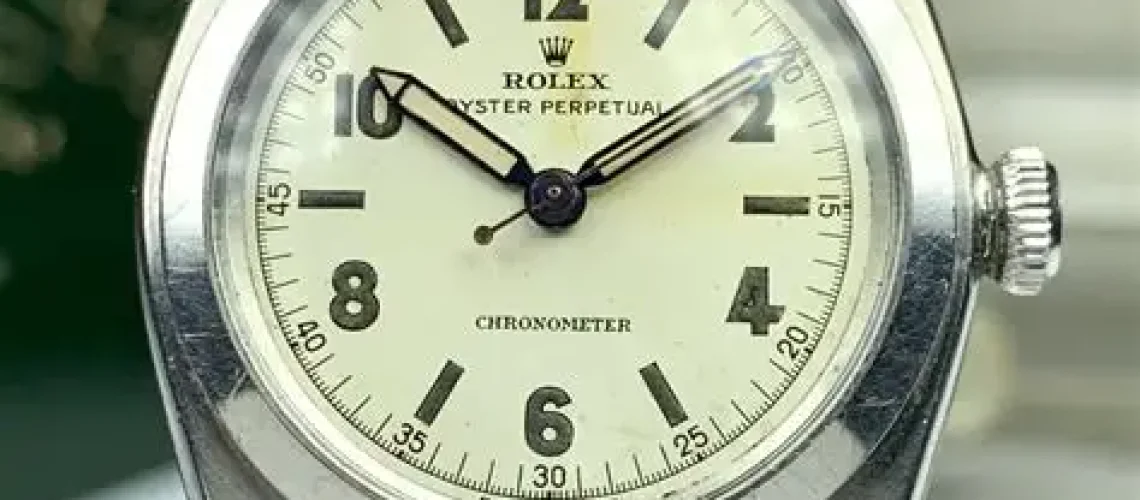

Meta Title: What Makes a Vintage Watch Collectible? | Vintage Watch Guide
Meta Description: What makes a vintage watch truly collectible? Learn how rarity, originality, condition, provenance, historical significance, reference importance, and market demand determine collectibility.
Suggested URL Slug: /what-makes-a-vintage-watch-collectible
Primary Keyword: what makes a vintage watch collectible
Secondary Keywords: vintage watch collecting, collectible watches, vintage watch value, rare vintage watches, vintage watch originality, watch provenance, vintage watch condition
Vintage watches are often described as collectible simply because they are old. But age alone does not make a watch important, desirable, or valuable.
There are countless watches that have survived for decades without developing significant collector interest. At the same time, certain references have become intensely desirable because they combine rarity, originality, historical significance, aesthetics, provenance, and cultural importance.
That distinction is fundamental to understanding vintage watch collecting.
A collectible watch is not merely an old watch. It is a watch that collectors have a reason to pursue.
Sometimes that reason is scarcity. Sometimes it is an unusual dial configuration. Sometimes it is a connection to an important moment in watchmaking history. In other cases, the appeal comes from untouched condition, documented ownership, or simply the fact that a particular reference represents an especially important chapter in the history of a brand.
Understanding what makes a vintage watch collectible can help buyers evaluate watches more intelligently and avoid paying premiums for characteristics that may not actually matter.
It also explains why two watches bearing the same reference number can sell for dramatically different amounts.
What Is Considered a Vintage Watch?
There is no universally accepted year at which a watch officially becomes vintage.
Collectors generally use the term to describe watches from an earlier era of watch production rather than simply anything that has reached a particular age.
Depending on the brand and collector community, watches from several decades ago are commonly described as vintage, while more recent discontinued watches may instead be referred to as neo-vintage.
The distinction matters because vintage watch collecting frequently places greater emphasis on originality, aging, production variations, and historical context than modern watch collecting.
A vintage watch has lived a life.
Its dial may have changed color. Its luminous material may have aged. Its case may show decades of wear. Its bracelet may have stretched. Its bezel may have faded.
Those characteristics can either enhance or reduce collectibility depending on the watch.
That is why vintage evaluation requires significantly more nuance than simply looking up a reference number.
1. Rarity Is One of the Foundations of Collectibility
Scarcity is one of the strongest forces in almost every collectible market.
If collectors want something that exists in limited quantities, competition naturally develops.
Vintage watches can become rare for several reasons.
A model may have been produced for only a short period. A specific dial configuration may have appeared during only a portion of production. A manufacturer may have made relatively few examples of a particular reference. Certain components may also have been replaced during servicing over the decades, making completely original examples increasingly difficult to find.
However, rarity by itself does not guarantee collectibility.
An obscure watch that almost nobody wants can be extremely rare while still having limited market value.
True collector demand generally requires a combination of scarcity and desirability.
Collectors have to care that the watch is rare.
This explains why certain subtle variations can create significant premiums. A dial variation that appears insignificant to a casual observer may represent a short production period that serious collectors have spent years studying.
The more advanced the collector base becomes, the more these distinctions tend to matter.
2. Originality Can Matter More Than Cosmetic Perfection
One of the biggest differences between buying modern and vintage watches is the importance of originality.
With a modern watch, buyers often want the watch to appear as close to new as possible.
Vintage collectors frequently think differently.
A perfectly refinished watch with replaced components may be less desirable than a visibly aged example that retains the parts with which it originally left the factory.
Collectors commonly evaluate components including:
- Dial
- Hands
- Bezel
- Crown
- Crystal
- Bracelet
- Movement
- Case
- Caseback
- Luminous material
Not every replacement component automatically ruins a vintage watch.
Watches were designed to be serviced, and many older watches naturally received replacement parts throughout their lives.
The critical issue is understanding which components are original, which have been replaced, and how those changes affect the desirability of that particular reference.
A service crystal, for example, may be viewed very differently from a refinished dial.
Likewise, a replaced crown may be considered less significant than replacement hands on a reference where collectors specifically prize the original hand configuration.
There is rarely a universal formula.
Knowledge of the individual model matters.
3. The Dial Is Often the Most Important Component
In vintage collecting, the dial can be one of the most important parts of the entire watch.
It is the component collectors see first, and it frequently contains many of the characteristics that differentiate one vintage example from another.
Collectors may examine:
- Printing style
- Logo placement
- Text spacing
- Luminous plots
- Hour markers
- Color
- Surface texture
- Aging patterns
- Manufacturing variations
Certain watches developed multiple dial generations during production.
Collectors may categorize those generations into distinct types, marks, or variations.
Even minor changes can become significant when a reference has been extensively researched.
Original dials can also become increasingly scarce because watches were routinely serviced during their working lives. A damaged or deteriorated dial might have been replaced because, at the time, owners were concerned with functionality rather than future collectibility.
Decades later, the surviving original dial may be exactly what collectors want.
This creates one of the great paradoxes of vintage collecting:
The qualities that once made a watch look old can eventually become the qualities that make it desirable.
4. Condition Matters, But Vintage Condition Is Complicated
Condition remains critically important.
But the definition of “good condition” is different for vintage watches than for modern ones.
A vintage watch should not necessarily look brand new.
In fact, excessive restoration can sometimes reduce collector appeal.
Collectors generally evaluate whether the condition is consistent with the age and history of the watch.
Important considerations include:
Case Geometry
Repeated polishing can gradually remove metal from a watch case.
Over time, originally sharp edges may become rounded, lugs may become thinner, and factory finishing can disappear.
For this reason, collectors often value cases that retain strong original proportions.
An unpolished or lightly polished example may receive a premium compared with a heavily refinished one.
However, determining whether a watch has truly never been polished requires experience.
The term “unpolished” is frequently used too casually in watch listings.
A more useful description is often to explain the actual observed condition of the case.
Dial Condition
Collectors may tolerate some dial aging, but damage is not automatically desirable.
Moisture intrusion, heavy spotting, corrosion, or significant deterioration can negatively affect value.
Attractive natural aging and actual damage should not be treated as the same thing.
Movement Condition
Collectibility should never completely overshadow mechanical health.
A beautiful vintage watch with an unhealthy or heavily modified movement can create substantial ownership problems.
Movement completeness, corrosion, replacement components, and service history should all be considered when evaluating a watch.
5. Patina Can Increase Desirability, But Not All Aging Is Good
Few words are used more frequently in vintage watch collecting than patina.
Patina refers broadly to visible changes that occur naturally with age.
Examples can include:
- Cream-colored luminous material
- Faded bezels
- Warm dial tones
- Tropicalized dial surfaces
- Changes in metal color
- Subtle oxidation
Certain types of aging are highly desirable because they give a watch visual character that cannot easily be reproduced.
But collectors should be careful.
Age does not automatically equal desirable patina.
A dial damaged by water is not automatically valuable because it changed color.
Uneven degradation is not necessarily desirable because it happened naturally.
What collectors usually respond to is attractive, coherent aging that complements the watch.
Patina should enhance the character of the piece rather than simply prove that the watch is old.
6. Historical Significance Can Transform a Watch Into a Collectible
Some watches matter because of what they represent.
A reference may have introduced an important technological development. It may have been associated with aviation, diving, motorsports, military service, scientific exploration, or another significant part of history.
A watch may also represent an important transition within a manufacturer’s history.
Examples include watches associated with:
- New movement technologies
- Early waterproof designs
- Professional diving
- Chronograph development
- Military contracts
- Space exploration
- Early automatic movements
- Important case innovations
Collectors are often buying more than an object.
They are buying a physical connection to a specific moment in horological history.
The stronger that historical narrative becomes, the greater the potential collector appeal.
7. Certain References Become Important Within a Brand’s History
Not every watch from a major manufacturer becomes equally collectible.
Within most brands, collectors eventually establish hierarchies.
Some references become foundational.
Others represent transitional periods.
Some introduce design elements that later become defining characteristics of the brand.
A vintage reference may become collectible because it represents:
- The first generation of a model
- The final generation using a particular movement
- A short-lived production variation
- A transitional dial
- A discontinued case size
- A historically important complication
- An iconic design era
Understanding the reference itself is therefore essential.
Buying a vintage watch based only on the brand name can be risky.
Two visually similar watches from the same manufacturer may have radically different collector significance.
8. Provenance Can Add Another Layer of Collectibility
Provenance refers to the documented history of an individual watch.
Strong provenance can significantly enhance collector interest.
Examples might include:
- Original purchase receipts
- Period photographs
- Service documentation
- Letters
- Military records
- Ownership documents
- Auction history
- Documentation connecting the watch to a notable individual or event
The key word is documentation.
A story without evidence should not be treated the same way as verified provenance.
Vintage watch collecting contains many appealing stories. Some are legitimate. Others have been exaggerated over time.
Collectors should distinguish between documented history and seller narrative.
When provenance is verifiable, however, it can make a watch genuinely unique.
There may be thousands of examples of a particular reference, but only one may have belonged to a historically important individual or participated in a documented event.
9. Box, Papers, and Accessories Can Increase Desirability
A vintage watch does not need its original box and papers to be collectible.
Many important watches survive without them.
During earlier decades, owners rarely imagined that packaging and receipts would eventually become valuable collector materials.
Original accessories can nevertheless increase desirability.
Depending on the watch, collectors may value:
- Original presentation box
- Guarantee papers
- Purchase receipt
- Instruction manuals
- Hang tags
- Chronometer certificates
- Original bracelet
- Spare links
- Service paperwork
- Period-correct accessories
These items provide additional historical context and sometimes help establish provenance.
A complete vintage set can therefore command a premium compared with an otherwise similar watch-only example.
But completeness should never distract from the watch itself.
A mediocre watch does not become exceptional simply because the box survives.
10. Production Variations Can Create Major Collector Interest
One of the most fascinating aspects of vintage watches is the number of small variations that occurred during manufacturing.
Before modern production became highly standardized, watches could evolve during relatively short periods.
Collectors may identify differences in:
- Dial typography
- Logos
- Bezels
- Handsets
- Crown designs
- Bracelet references
- Casebacks
- Luminous compounds
- Movement components
- Serial-number ranges
These details may create subcategories within a single reference.
For a casual buyer, two watches may appear virtually identical.
For a specialist, they may represent completely different levels of rarity.
This is why reference-specific research is essential before purchasing expensive vintage watches.
The market often values details that are invisible until you know where to look.
11. Cultural Importance Can Increase Collectibility
Some watches transcend traditional watch collecting and become cultural objects.
This can happen through association with:
- Famous actors
- Athletes
- Musicians
- Explorers
- Racing drivers
- Political figures
- Films
- Television
- Major cultural movements
Sometimes the association is direct and documented.
Other times, a watch simply becomes representative of a particular era.
Cultural relevance can introduce entirely new groups of collectors into the market.
Someone may become interested in a particular watch because of motorsports rather than horology.
Another buyer may appreciate a model because of film history.
When collector interest expands beyond the traditional watch community, demand can become considerably stronger.
12. Design Matters More Than Many Collectors Admit
Collectors enjoy discussing references, movements, rarity, and provenance.
But sometimes a watch becomes collectible for a much simpler reason:
It looks great.
Design has enormous influence on long-term desirability.
Certain watches retain relevance because their proportions, dial layouts, case shapes, and overall aesthetics remain compelling decades after production.
The strongest vintage designs often feel representative of their era without looking completely trapped in it.
A watch that remains wearable and visually interesting generations later has a significant advantage.
Collector markets are ultimately driven by human preference.
People need to want the object.
13. Brand Reputation Influences Collector Confidence
Brand recognition also plays an important role.
Manufacturers with well-documented histories tend to attract larger collector communities.
Collectors can research production details, reference histories, movement variations, and known examples.
Established collector communities also create infrastructure around a brand.
That infrastructure may include:
- Reference books
- Collector forums
- Auction archives
- Specialist dealers
- Historical research
- Museum archives
- Watchmaker expertise
The greater the available knowledge, the easier it becomes for collectors to understand exactly what they are buying.
However, lesser-known brands should not automatically be ignored.
Some historically significant manufacturers remain underappreciated precisely because mainstream collectors have not studied them as extensively.
14. Market Demand Ultimately Determines Collectibility
A watch can theoretically possess every desirable characteristic and still struggle to attract buyers.
Collector markets require demand.
Demand may come from established collectors, new enthusiasts, dealers, museums, auction houses, or broader cultural interest.
A strong collectible market typically develops when several factors intersect:
Rarity + historical significance + attractive design + originality + collector knowledge + demand.
The relative importance of each factor varies.
One reference may be desirable primarily because it is historically significant.
Another may command attention because extremely few original examples survive.
Another might be common but overwhelmingly popular because its design has become iconic.
There is no single formula.
15. Collector Consensus Develops Over Time
Collectibility is rarely decided by one person.
It develops gradually.
Collectors study production records.
Researchers identify variations.
Auction houses document important examples.
Dealers encounter watches in the market.
Owners share information.
Books are published.
Communities debate originality and production details.
Over time, a consensus often emerges around which configurations are especially important.
This is why vintage watch scholarship matters.
The understanding of certain references can evolve as new examples and documentation appear.
A configuration once considered insignificant may become highly desirable after collectors realize how rarely it was produced.
16. Collectibility and Investment Are Not the Same Thing
One of the biggest mistakes newcomers make is treating the words collectible and investment as interchangeable.
They are not.
A watch can be historically important and highly collectible while still declining in market value.
Another watch may increase dramatically in price despite having relatively little historical significance.
Financial performance depends on factors beyond collector merit, including market sentiment, liquidity, economic conditions, fashion, availability, and buyer demand.
Collectors should therefore separate two questions:
Is this an important watch?
and
Is this a financially attractive purchase at the current price?
Those are not always the same question.
How to Evaluate a Vintage Watch Before Buying
Before purchasing a vintage watch, consider evaluating it in several stages.
Verify the Reference
Confirm exactly which reference and production era you are evaluating.
Study Known Variations
Research dial types, bezel configurations, handsets, bracelets, movements, and other reference-specific characteristics.
Evaluate Originality
Determine which components appear original and which may have been replaced.
Inspect Condition
Look closely at the dial, case, movement, bezel, hands, bracelet, and luminous material.
Investigate Provenance
Ask for documentation when historical claims materially influence the price.
Compare Similar Examples
Compare the watch with examples of the same configuration rather than relying on generic reference-level pricing.
Consider Service Needs
A vintage watch may require specialized mechanical attention.
The cost and availability of replacement parts should be considered before purchase.
Buy the Example, Not Just the Reference
This may be the most important principle in vintage collecting.
Two watches sharing the same reference can have dramatically different collector appeal depending on originality, condition, documentation, and configuration.
Frequently Asked Questions About Vintage Watch Collectibility
Does a vintage watch have to be rare to be collectible?
No. Some highly collectible watches were produced in substantial quantities. Strong design, historical importance, brand recognition, and sustained collector demand can make a relatively common reference highly collectible.
Are unpolished vintage watches worth more?
Collectors often prefer watches that retain strong original case geometry. However, claims of being completely unpolished can be difficult to verify. Condition should be evaluated individually rather than relying solely on listing terminology.
Does patina increase the value of a vintage watch?
Sometimes. Attractive natural aging can enhance collector desirability, but damage and deterioration should not automatically be considered desirable patina.
Are vintage watches with replacement parts still collectible?
Yes. Many vintage watches received replacement components during normal servicing. The impact depends on which component was replaced, whether the replacement is period-correct or service-issued, and how important originality is for that specific reference.
Are box and papers necessary?
No. Many important vintage watches no longer have their original packaging or documents. However, original accessories and documentation can increase desirability and help establish provenance.
Is an older watch always more collectible?
No. Age alone does not create collector demand. Historical significance, originality, rarity, condition, aesthetics, and market interest are generally more important.
Final Thoughts: What Really Makes a Vintage Watch Collectible?
The most collectible vintage watches usually sit at the intersection of several characteristics.
They may be rare.
They may remain remarkably original.
They may have survived in exceptional condition.
They may represent a historically important moment.
They may feature an unusual production variation.
They may have extraordinary provenance.
Or they may simply embody a design collectors continue to love decades after production ended.
The important lesson is that collectibility comes from context, not age alone.
A vintage watch should be evaluated as an individual historical object rather than merely a reference number.
The deeper you go into vintage collecting, the more significant the small details become. Dial printing, case geometry, luminous material, bracelet references, serial ranges, service history, and ownership documentation can all transform how collectors understand a particular watch.
That complexity is part of what makes vintage watch collecting so rewarding.
Every surviving watch is slightly different.
Every example has experienced a different life.
And when rarity, originality, history, condition, and desirability come together in the right watch, the result can become far more than an old timepiece.
It becomes a collectible.