
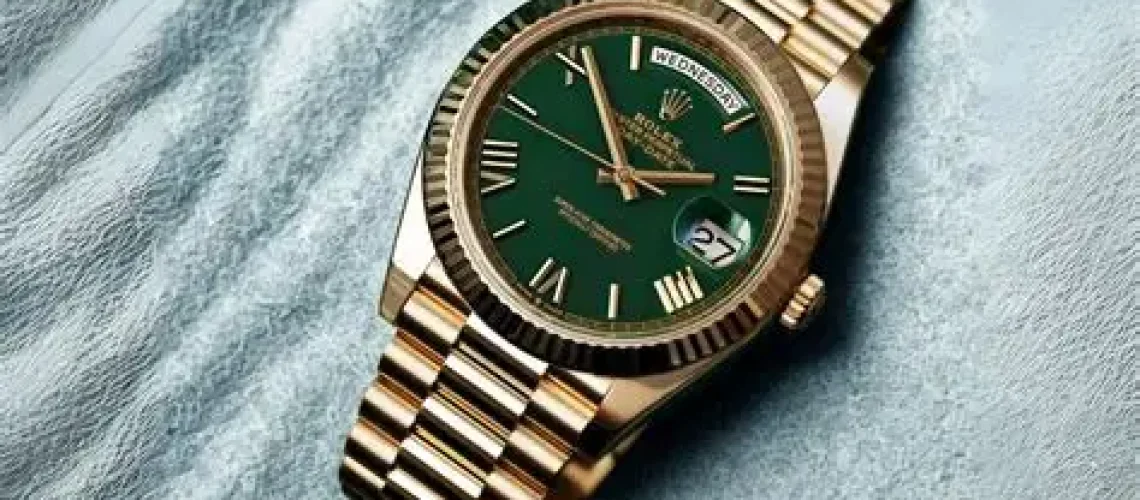

Mention luxury watches to someone who knows almost nothing about watches, and there is a strong chance that Rolex will be the first brand that comes to mind.
That level of recognition extends far beyond the watch community. The Rolex crown is associated with achievement, wealth, durability, professional success, and personal milestones. A person may not understand movements, reference numbers, complications, or case construction, but they probably understand what owning a Rolex represents.
That position was not created by one watch, one celebrity endorsement, or one successful advertising campaign. Rolex spent more than a century building a remarkably consistent system around technical credibility, memorable design, cultural visibility, controlled distribution, and emotional symbolism.
The results are measurable. Brand Finance ranked Rolex as the strongest luxury and premium brand in its 2024 study. In 2025, the organization valued the Rolex brand at CHF 15.9 billion, placing it among Switzerland’s most valuable brands across all industries, not merely watchmaking.
Understanding how Rolex reached that position requires looking beyond watches. Rolex did not simply manufacture successful products. It created one of the most disciplined brand-building systems in modern luxury.
Rolex Started With a Clear and Memorable Name
The story begins with Hans Wilsdorf.
In 1905, at the age of 24, Wilsdorf founded a London business specializing in the distribution of timepieces. At the time, wristwatches were often viewed as less reliable than pocket watches. Wilsdorf believed that a wristwatch could eventually become both elegant and dependable.
That belief was important because Rolex was not initially competing only against other watch companies. Wilsdorf was attempting to change how the public thought about wristwatches as a category.
In 1908, he registered the name Rolex. According to Rolex’s own historical account, Wilsdorf experimented with hundreds of letter combinations before settling on the compact five-letter name.
The name provided several branding advantages:
- It was short enough to fit clearly on a watch dial.
- It did not tie the company too closely to one founder’s surname.
- It could be presented consistently across international markets.
- It was visually simple and easy to repeat.
Many early watches were sold through jewelers whose names appeared prominently on the dial. Wilsdorf understood that long-term recognition would require consumers to remember the manufacturer, not only the retailer.
Rolex therefore began developing something unusual for the early watch industry: a consumer-facing brand identity.
Rolex Built Its Reputation on Measurable Performance
Luxury branding cannot survive indefinitely without a credible product behind it.
Rolex established that credibility through precision testing. In 1910, a Rolex watch became the first wristwatch to receive the Swiss Certificate of Chronometric Precision from the Official Watch Rating Centre in Bienne. In 1914, a Rolex wristwatch received a Class “A” precision certificate from Kew Observatory, a distinction previously associated with marine chronometers.
These achievements gave Rolex a foundation that was stronger than vague claims about quality.
The company could point to external testing and documented performance.
This became one of Rolex’s most effective long-term strategies: identify a practical problem, develop a technical solution, test that solution under credible conditions, and then communicate the result in language the public could understand.
Consumers did not need to understand every component inside the movement. They only needed to understand that the watch had been tested and proven accurate.
Rolex would eventually apply that same formula to water resistance, automatic winding, diving, aviation, mountaineering, motor racing, and deep-sea exploration.
The Oyster Turned Engineering Into a Public Story
One of the most important developments in Rolex history arrived in 1926 with the Rolex Oyster.
The Oyster was designed to protect the movement against water and dust. However, creating the watch was only part of the challenge. Rolex also needed to convince the public that a waterproof wristwatch could genuinely work.
Wilsdorf found a way to demonstrate that capability dramatically.
In 1927, English swimmer Mercedes Gleitze crossed the English Channel while wearing a Rolex Oyster. The swim lasted more than ten hours, and the watch remained operational afterward. Rolex then promoted the achievement with a full-page advertisement on the front page of the Daily Mail.
This was much more powerful than a traditional product advertisement.
Rolex had placed the watch inside a real human achievement. The public was not simply being told that the Oyster was waterproof. It was being shown a memorable test involving endurance, risk, and accomplishment.
Rolex describes this campaign as the beginning of its “Testimonee” concept. Rather than relying only on conventional celebrity endorsements, the brand associated itself with people whose achievements reflected the performance of the watches.
The distinction matters.
A celebrity can provide attention. An explorer, athlete, pilot, or record-breaker can provide evidence.
Rolex Connected Its Watches to Achievement
During the following decades, Rolex repeatedly placed its watches in demanding environments.
The company treated sports, aviation, expeditions, and motor racing as what it called “living laboratories” for testing and showcasing the Oyster. In the 1930s, Rolex watches accompanied aviation expeditions and were worn by British racing driver Sir Malcolm Campbell during his pursuit of land-speed records.
The strategy reinforced a specific message:
A Rolex was not merely an expensive object. It was equipment for people doing significant things.
That association helped Rolex occupy a valuable position between two categories.
It offered the durability and practicality of a professional instrument while carrying the prestige and finish of a luxury product.
Most brands struggle to maintain both identities. A highly technical watch can feel too utilitarian. A highly decorative watch can feel too delicate. Rolex built much of its appeal around the idea that one watch could represent both performance and success.
This dual identity remains central to the brand.
A Submariner can be recognized as a diving watch even when worn with a suit. A Day-Date can represent wealth while still belonging to the same Oyster-based family as Rolex’s professional models. A GMT-Master II can be both an aviation tool and one of the most commercially desirable luxury watches in the world.
The Perpetual Rotor Made Rolex Easier to Own
In 1931, Rolex introduced and patented its self-winding system using a Perpetual rotor. The rotor could move with the wearer’s wrist and wind the movement automatically.
This innovation contributed to the “Oyster Perpetual” identity that would eventually appear across a significant portion of the Rolex collection.
From a branding perspective, the importance of the Perpetual system went beyond mechanical engineering.
Rolex was making the wristwatch more practical.
A watch that resisted water, protected its movement, maintained strong precision, and wound itself through normal wear was easier for the average owner to trust. Rolex was not selling complication for complication’s sake. It was using engineering to reduce the inconveniences associated with wearing a mechanical watch.
This practical approach helped Rolex reach consumers who wanted quality and prestige but were not necessarily traditional horological experts.
That audience would eventually become enormous.
Rolex Created Designs That Could Be Recognized Instantly
Recognition depends on repetition.
Rolex did not continually abandon its successful designs to chase every new trend. It established a visual language and refined it gradually.
The Datejust, introduced in 1945, became a particularly important part of that language. Rolex describes it as the first self-winding wrist chronometer to display the date in a window on the dial. The model was originally fitted with the Jubilee bracelet and a fluted bezel, two elements that helped make it immediately recognizable.
Over time, several Rolex design features became recognizable even without a clear view of the logo:
- The fluted bezel
- The Cyclops date magnifier
- The Oyster bracelet
- The Jubilee bracelet
- Mercedes-style hour hands
- Large luminous hour markers
- The coronet logo
- Distinctive two-color GMT bezels
- The President bracelet
- The familiar proportions of the Oyster case
Rolex did not invent every visual feature associated with its watches, but it used those features with exceptional consistency.
That consistency created a form of visual memory.
A consumer could see a watch from across a room and identify it as a Rolex. Even when another company produced a similar design, the comparison often strengthened Rolex’s position because the Rolex remained the reference point.
Rolex Built Models Around Easily Understood Identities
Rolex model names are generally direct and easy to associate with a function or environment.
The Explorer suggests exploration. The Submariner suggests diving. The GMT-Master suggests international travel. The Sea-Dweller suggests deep-sea use. The Cosmograph Daytona suggests motor racing.
These identities made the collection easier to understand.
In 1953, the expedition during which Edmund Hillary and Tenzing Norgay reached the summit of Mount Everest was equipped with Oyster Perpetual watches. Rolex launched the Explorer that year in connection with the historic ascent. The Submariner was also launched in 1953 as a divers’ watch waterproof to 100 meters, with a rotating bezel that allowed divers to monitor immersion time.
These watches were not presented as abstract exercises in fine watchmaking. Each belonged to a story that consumers could understand immediately.
The person buying an Explorer did not need to climb Everest. The watch allowed the owner to connect with the idea of exploration.
The person buying a Submariner did not need to be a professional diver. The watch still communicated capability, toughness, and adventure.
Rolex understood that consumers often purchase the meaning surrounding a product in addition to the product itself.
Rolex Balanced Innovation With Continuity
Many watch brands face a difficult decision.
Change too little, and the collection can become stale. Change too much, and the company risks weakening the designs that made it recognizable.
Rolex usually follows a more gradual approach.
Cases, movements, bracelets, clasps, bezels, materials, and manufacturing techniques evolve, but the underlying identity of the models remains familiar. A modern Submariner is technically and materially different from an early Submariner, yet the relationship between the two is immediately visible.
This continuity has several benefits.
First, it protects brand recognition. Customers do not need to relearn the collection every few years.
Second, it strengthens the vintage market. Older watches remain visually connected to current production.
Third, it gives consumers confidence that a watch purchased today will not appear completely disconnected from the brand’s future direction.
Rolex has continued introducing new technology. In 2013, for example, the company introduced a blue-and-black two-color Cerachrom ceramic bezel insert on the GMT-Master II. Rolex followed with a red-and-blue version the next year. The company described producing two colors on a single ceramic component as a watchmaking milestone.
The important point is that the technology served an established model identity. Rolex modernized the familiar GMT bezel instead of discarding it.
Rolex Placed Itself Beside Institutions, Not Trends
Rolex’s sponsorship strategy is another major reason for its global recognition.
The brand has consistently associated itself with sports and cultural institutions that represent tradition, excellence, precision, and international achievement.
Rolex has served as Wimbledon’s Official Timepiece since 1978. It later expanded its involvement across major tennis events, including all four Grand Slam tournaments.
The value of a partnership such as Wimbledon is not limited to logo exposure.
Wimbledon possesses many of the qualities Rolex wants consumers to associate with its watches:
- Tradition
- Global recognition
- Controlled presentation
- Excellence under pressure
- Respect for history
- Gradual modernization
- Exclusivity without constant reinvention
Rolex has developed similar associations in golf, yachting, equestrian sports, motor racing, exploration, architecture, and the arts.
In 2017, Rolex became the Exclusive Watch of the Academy of Motion Picture Arts and Sciences and a Founding Supporter of the Academy Museum of Motion Pictures.
These partnerships place Rolex beside institutions that are larger and more enduring than individual personalities.
An athlete’s popularity can decline. A film star’s public image can change. An established global event can deliver recognition across generations.
Rolex Advertising Rarely Focuses on Price
Rolex advertising usually does not attempt to convince the audience that its watches are inexpensive, accessible, or financially sensible.
Instead, the communication centers on achievement, permanence, precision, and legacy.
This protects the brand from competing primarily on specifications or discounts.
A watch enthusiast may compare accuracy, finishing, movement architecture, power reserve, case thickness, and complications. The wider public usually makes a simpler comparison.
They ask what the watch represents.
Rolex has spent decades answering that question consistently. It represents having reached an important point.
That milestone might be a promotion, business success, retirement, wedding, birthday, graduation, or personal recovery. The watch becomes physical evidence of the event.
This emotional function is one reason Rolex recognition extends beyond traditional collectors.
Controlled Availability Strengthened Desire
Rolex’s retail structure has also contributed to its positioning.
The brand sells new watches through an authorized distribution network rather than relying on constant discounting or uncontrolled mass-market availability. Demand for certain models has frequently exceeded immediate retail supply, making access part of the ownership experience.
Scarcity alone does not create a powerful luxury brand. An unwanted product remains unwanted even when production is limited.
However, scarcity can intensify desire when the product already has strong recognition, proven quality, consistent design, and cultural status.
Rolex entered that cycle from a position of strength.
As more buyers pursued difficult-to-obtain models, those models received more attention. The attention increased their visibility. Greater visibility attracted new buyers. The secondary market made pricing and availability visible to consumers around the world.
This created a powerful feedback loop around models such as the Daytona, Submariner, GMT-Master II, and certain Datejust configurations.
The danger is assuming that scarcity alone explains Rolex.
It does not.
Rolex had already spent decades creating recognizable products and global demand. Limited retail availability amplified an existing brand advantage rather than creating it from nothing.
The Secondary Market Keeps Rolex Visible
Rolex benefits from one of the most active secondary markets in the watch industry.
Pre-owned examples are sold through dealers, auction houses, online marketplaces, private collectors, and Rolex’s own Certified Pre-Owned program. The result is that Rolex remains visible even when a consumer is not shopping directly through an authorized retailer.
A buyer can compare watches from different decades and see a clear design lineage. A vintage Datejust, five-digit Submariner, modern GMT-Master II, and current Oyster Perpetual all contribute to the same broader brand ecosystem.
That continuity is difficult to reproduce.
Some brands have changed ownership, altered their design language, abandoned important collections, or repositioned themselves repeatedly. Rolex’s core models have generally remained connected to their historical identities.
The pre-owned market therefore functions as both a sales channel and an enormous archive of Rolex design.
Rolex Became More Than a Watch Company
The final stage of Rolex’s brand development was cultural.
The name Rolex eventually became shorthand for a category of success.
This does not mean every collector considers Rolex the greatest watchmaker. Many companies produce more complicated movements, rarer watches, more hand-finishing, or more unconventional designs.
Recognition and horological complexity are not the same thing.
Rolex succeeded because its message could be understood by both specialists and non-specialists.
Collectors could appreciate references, movements, dial variations, production changes, and historical details. The general public could appreciate the crown, the name, the appearance, and the social meaning.
Few watch brands communicate effectively to both groups.
Rolex does.
Why Rolex Remains So Recognizable
Rolex’s position can be reduced to several interconnected principles:
- A simple global identity: The short name and crown logo are easy to remember.
- Documented technical credibility: Precision and durability claims were supported by testing and real-world use.
- Demonstration-based marketing: Rolex showed its watches performing during meaningful achievements.
- Consistent visual design: Core design features were repeated and refined across generations.
- Clear model identities: Watches were connected to diving, travel, exploration, racing, and leadership.
- Prestigious long-term partnerships: Rolex aligned itself with established global institutions.
- Controlled distribution: The brand protected its positioning rather than competing through discounts.
- A strong secondary market: Older watches continue reinforcing the visibility of current models.
- Emotional significance: Rolex became a common way to commemorate personal achievement.
- Patience: The company built recognition over decades rather than chasing temporary attention.
Final Thoughts
Rolex did not become the world’s most recognized watch brand simply by making expensive watches.
It built technical credibility before transforming that credibility into stories. It created professional instruments before turning those instruments into cultural symbols. It developed recognizable designs and resisted the temptation to reinvent them every few years. It associated its watches with achievement, then gave customers a way to associate their own achievements with the brand.
The most important part of the Rolex strategy may be its consistency.
For more than a century, the details evolved while the central promise remained stable: a Rolex is a precise, durable, recognizable watch connected to accomplishment.
That promise is simple enough for almost anyone to understand.
Executing it consistently across products, advertising, distribution, sports, culture, and generations is what made Rolex extraordinary.