
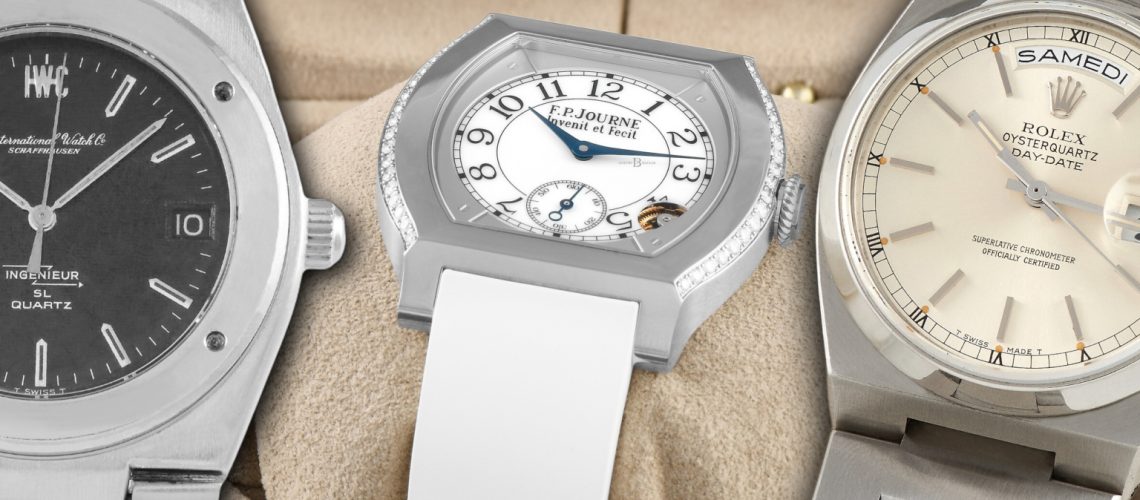

Quartz watches are everywhere. They can be found in inexpensive department-store watches, rugged digital sports watches, fashion watches, and luxury timepieces costing thousands of dollars. Yet despite being the most common type of watch movement in the world, quartz watches are often misunderstood by collectors.
Some enthusiasts dismiss quartz because it lacks the complex gears, springs, and traditional craftsmanship associated with mechanical watches. Others appreciate quartz watches for precisely the reasons mechanical watches struggle: accuracy, reliability, affordability, and convenience.
So, what exactly is a quartz watch, and how does a quartz movement work?
In simple terms, a quartz watch uses electricity and a tiny quartz crystal to regulate timekeeping. Instead of relying primarily on a mechanical balance wheel to control the movement, quartz watches use the extremely consistent vibration of quartz as their timekeeping reference.
That seemingly simple technological difference transformed the entire watch industry.
This guide explains how quartz watches work, why they are so accurate, how they compare with mechanical watches, their advantages and disadvantages, and whether quartz watches deserve a place in a serious watch collection.
What Is a Quartz Watch?
A quartz watch is a watch whose timekeeping is regulated electronically using a quartz crystal oscillator.
Most traditional quartz wristwatches receive electrical power from a small battery. That electricity passes through a quartz crystal, causing it to vibrate at a highly consistent frequency.
The watch’s electronic circuitry measures those vibrations and converts them into regular electrical pulses.
Those pulses then control the time display.
In an analog quartz watch, the electronic signal typically operates a small stepper motor that moves the hands through the watch’s gear train.
In a digital quartz watch, the electronic circuit processes the signal and displays the time electronically, usually on an LCD or similar display.
Regardless of whether the watch has hands or a digital screen, the underlying principle is similar:
The quartz crystal provides an extremely stable reference for measuring time.
Why Is Quartz Used in Watches?
Quartz has a useful physical property known as the piezoelectric effect.
When electrical voltage is applied to quartz, the crystal can deform and vibrate. Conversely, mechanical pressure applied to quartz can generate an electrical charge.
Watchmakers and electronics manufacturers can cut and shape quartz crystals so that they oscillate at a very predictable frequency when electricity is applied.
A commonly used frequency in quartz wristwatches is:
32,768 Hz
That means the crystal oscillates 32,768 times per second.
Why such a specific number?
Because 32,768 equals 2¹⁵. Electronic circuitry can repeatedly divide that frequency by two until it produces a one-second timing signal.
That gives the watch an extraordinarily consistent electronic heartbeat.
How Does a Quartz Watch Work?
Although quartz watches can contain surprisingly sophisticated technology, their basic operation can be broken down into several components.
1. The Battery Supplies Electricity
In a conventional quartz watch, a small battery provides electrical energy to the movement.
Because quartz movements require relatively little energy, many quartz watches can operate for several years before needing a replacement battery.
Exact battery life varies considerably depending on the movement and additional complications.
Functions such as:
- chronographs
- alarms
- backlighting
- perpetual calendars
- multiple digital displays
can increase power consumption.
Some quartz watches eliminate conventional battery replacement almost entirely by using solar charging systems.
2. Electricity Activates the Quartz Crystal
The battery supplies power to the movement’s electronic circuit.
A small electrical charge is applied to the quartz crystal.
Because of quartz’s piezoelectric properties, the crystal begins vibrating at a highly consistent frequency.
In many quartz watch movements, this frequency is 32,768 vibrations per second.
3. The Circuit Counts the Vibrations
An integrated circuit receives the quartz oscillator’s signal.
It repeatedly divides the frequency until it produces a precise timing reference.
Eventually, those thousands of vibrations are converted into a signal corresponding to one second.
This electronic regulation is one of the main reasons quartz watches can maintain significantly greater everyday accuracy than most conventional mechanical wristwatches.
4. The Motor Moves the Hands
In a traditional analog quartz watch, the electronic signal activates a tiny stepper motor.
The motor transfers energy through gears that move the watch hands.
This is responsible for the familiar movement found on many quartz watches where the seconds hand appears to advance once each second.
However, not every quartz watch behaves this way.
Some quartz watches use:
- multiple steps per second
- smoothly advancing seconds hands
- chronograph motors
- independent motors for different hands
Therefore, a ticking seconds hand alone does not tell you everything about the sophistication of a quartz movement.
Are Quartz Watches More Accurate Than Mechanical Watches?
Generally, yes.
Quartz watches are typically significantly more accurate than conventional mechanical watches.
Mechanical watches regulate time using a mechanical oscillator consisting primarily of a balance wheel and hairspring.
That system can be affected by numerous variables, including:
- temperature
- gravity
- position
- lubrication
- shock
- magnetism
- component tolerances
- power reserve
Watchmakers can regulate mechanical watches to impressive levels of precision, but the system remains fundamentally mechanical.
Quartz crystals oscillate far more rapidly and consistently than mechanical balance wheels.
As a result, even relatively inexpensive quartz watches can achieve levels of timekeeping consistency that would require considerable engineering in a traditional mechanical watch.
Some specialized quartz movements go even further.
High-accuracy quartz, sometimes abbreviated HAQ, can incorporate technologies such as temperature compensation and advanced electronic regulation to reduce deviation even further.
Exact accuracy specifications depend on the individual watch and movement.
Quartz vs. Automatic Watches
One of the most common questions new watch buyers ask is:
Is quartz better than automatic?
There is no universal answer because they prioritize different qualities.
Quartz Watches
Quartz watches generally offer:
- greater accuracy
- lower maintenance requirements
- lower manufacturing costs
- greater resistance to everyday disturbances
- longer periods between servicing
- convenient grab-and-go operation
If you leave a battery-powered quartz watch in a drawer for several days, it will normally continue running.
Automatic Watches
Automatic watches are mechanical watches that use a rotor to wind the mainspring through the motion of the wearer’s wrist.
Collectors often value automatic watches because of their:
- mechanical engineering
- craftsmanship
- historical significance
- finishing
- traditional construction
- visible movement architecture
An automatic watch does not require a conventional battery to keep running, but it will eventually stop when its stored mechanical energy is depleted.
For enthusiasts, that mechanical interaction is part of the appeal.
Which Is Better?
If your primary priorities are accuracy, convenience, and reliability, quartz has a substantial advantage.
If you are primarily interested in traditional watchmaking, mechanical engineering, craftsmanship, and collecting, mechanical watches may provide a more engaging experience.
Neither technology automatically makes a watch better.
They simply approach timekeeping differently.
Why Do Quartz Watches Tick Once Per Second?
Many quartz watches are recognizable by their seconds hand moving in distinct one-second increments.
This happens because the electronic circuitry sends an electrical pulse to the stepper motor at regular intervals.
However, the assumption that:
Quartz = ticking hand
and
Mechanical = sweeping hand
is not completely accurate.
Mechanical watches do not usually produce a perfectly smooth sweep either.
The seconds hand advances several times per second depending on the movement’s operating frequency, creating the visual impression of smoother motion.
Likewise, some quartz movements move their seconds hands multiple times per second or use systems specifically designed to create smoother motion.
The movement of the seconds hand can provide clues about the watch’s technology, but it should not be treated as a universal identification rule.
Advantages of Quartz Watches
Quartz technology became enormously successful because it solved several practical problems associated with mechanical timekeeping.
Exceptional Accuracy
Accuracy remains the strongest practical advantage of quartz watches.
Quartz regulation provides remarkably consistent timekeeping without requiring frequent mechanical adjustment.
For someone who simply wants to know the correct time, quartz is difficult to beat.
Low Maintenance
Mechanical watches contain numerous moving components that eventually require cleaning, lubrication, adjustment, or replacement.
Quartz watches usually contain fewer mechanically stressed components.
They are not maintenance-free, but their service requirements can be considerably simpler.
Convenience
Put on a functioning quartz watch and it is usually ready to go.
There is generally no need to:
- wind it
- reset it after several days off the wrist
- monitor its power reserve
- keep it on a watch winder
For people with larger watch collections, this convenience can be particularly useful.
Affordability
Quartz movements can be mass-produced efficiently.
As a result, manufacturers can produce accurate, reliable watches at relatively low prices.
This helped make dependable wristwatches accessible to enormous numbers of consumers.
Durability
The simplicity of many quartz movements makes them well suited to sports watches, military-style watches, outdoor watches, and everyday wear.
That does not mean every quartz watch is automatically rugged, but the technology can lend itself extremely well to durable designs.
Disadvantages of Quartz Watches
Quartz watches are excellent tools, but collectors may find several aspects less compelling.
Less Mechanical Interaction
Part of the romance of mechanical watch collecting comes from knowing that hundreds of precisely manufactured components may be working together on your wrist.
Quartz replaces much of that mechanical regulation with electronics.
For some collectors, that makes the watch feel less emotionally engaging.
Battery Replacement
Traditional quartz watches eventually require battery replacement.
Depending on the watch’s design, replacing the battery may also involve checking seals or testing water resistance.
Leaving a depleted battery inside a watch for an extended period can also be undesirable because damaged batteries can potentially leak.
Repairability Can Vary
Some high-quality quartz movements can be serviced.
Others are designed so economically that replacing the entire movement may be more practical than repairing individual electronic components.
This differs from many traditional mechanical movements, which were designed with long-term servicing in mind.
Collector Perception
Quartz watches sometimes suffer from a perception problem within enthusiast communities.
Because extremely inexpensive watches frequently use quartz movements, some collectors incorrectly associate quartz technology itself with low quality.
But movement technology and overall watch quality are separate questions.
A watch can be quartz-powered while still featuring exceptional:
- case construction
- dial finishing
- bracelet quality
- design
- materials
- engineering
Quartz should be viewed as a type of movement rather than a quality category.
Can Quartz Watches Be Luxury Watches?
Absolutely.
Luxury watchmaking is not limited to mechanical movements.
Numerous respected manufacturers have produced sophisticated quartz watches, and quartz technology has appeared across many segments of the luxury industry.
High-end quartz watches may feature:
- beautifully finished cases
- precious metals
- advanced movement construction
- temperature-compensated regulation
- perpetual calendars
- sophisticated power-management systems
- extremely precise motors
- specialized quartz oscillators
The assumption that a quartz movement automatically makes a watch inexpensive ignores the rest of the watch.
Movement architecture matters, but luxury can also involve design, manufacturing quality, finishing, materials, rarity, heritage, and engineering.
What Is High-Accuracy Quartz?
Most quartz watches are already quite accurate.
High-accuracy quartz watches take the concept significantly further.
Temperature is one of the factors that can affect quartz oscillation.
Advanced quartz movements may therefore monitor temperature and compensate for those changes electronically.
Manufacturers may also carefully select quartz crystals and calibrate individual movements.
The result can be exceptionally precise timekeeping.
These movements demonstrate an important point:
Quartz technology is not necessarily simplistic.
At the high end, quartz watchmaking can involve substantial engineering.
What Is Solar Quartz?
A solar quartz watch uses light to generate electrical energy.
Small photovoltaic cells convert light into electricity, which is stored in a rechargeable energy-storage system.
The watch then operates like another electronically regulated quartz watch.
Solar technology solves one of the major inconveniences associated with traditional quartz watches: periodic disposable battery replacement.
Depending on the watch, both sunlight and artificial light may contribute to charging.
Solar quartz is particularly appealing for buyers who want:
- quartz accuracy
- minimal maintenance
- long-term convenience
- everyday reliability
Do Quartz Watches Need Servicing?
Yes, although their maintenance requirements are often relatively modest.
A quartz watch may eventually require:
- battery replacement
- gasket replacement
- water-resistance testing
- cleaning
- movement inspection
- coil replacement
- motor repair
- electronic component replacement
Service needs vary dramatically by watch.
Water-resistant watches deserve particular attention because opening the case for a battery replacement can affect seals.
Anyone relying on a watch for swimming or diving should follow the manufacturer’s recommendations regarding water-resistance testing and maintenance.
How Long Does a Quartz Watch Last?
A well-made quartz watch can potentially operate for decades with appropriate maintenance.
However, there is no universal lifespan.
Longevity depends on factors including:
- movement quality
- parts availability
- moisture exposure
- corrosion
- battery leakage
- physical damage
- maintenance
- manufacturer support
Electronic components can eventually fail, just as mechanical components can.
The practical longevity of a specific quartz watch therefore depends heavily on its construction and whether replacement parts or compatible movements remain available.
Are Quartz Watches Collectible?
Yes.
Collectors increasingly evaluate watches based on much more than movement type.
A quartz watch can become collectible because of its:
- design
- rarity
- historical significance
- manufacturer
- condition
- provenance
- unusual technology
- cultural importance
The emergence of quartz technology represents one of the most important technological developments in modern watchmaking.
Ignoring quartz entirely means ignoring a major chapter of horological history.
Vintage quartz watches can also present interesting collecting opportunities because surviving examples may represent experimental technologies or distinctive periods of industrial design.
That said, collectibility should always be evaluated watch by watch.
A watch being old, quartz, rare, or discontinued does not automatically make it valuable.
Are Quartz Watches Worth Buying?
For many buyers, absolutely.
Quartz watches are particularly compelling if you prioritize:
- dependable accuracy
- convenience
- low maintenance
- affordability
- durability
They can also make excellent additions to collections dominated by mechanical watches.
A collector might own complicated mechanical watches while keeping a quartz watch for travel, sports, casual wear, or situations where convenience matters more than mechanical fascination.
Quartz watches also make excellent entry points into watch collecting.
A buyer does not need to understand escapements, beat rates, mainsprings, or power reserves to enjoy a well-designed quartz watch.
Should Watch Collectors Respect Quartz?
Quartz deserves considerably more respect than it sometimes receives.
Mechanical watchmaking is fascinating precisely because it uses intricate mechanical systems to solve the problem of measuring time.
Quartz watchmaking solved the same problem differently.
And from the perspective of pure timekeeping performance, it solved it extremely effectively.
That accomplishment changed consumer expectations around watch accuracy and helped reshape the global watch industry.
Mechanical watches survived not because quartz failed, but because watches eventually became more than instruments for telling time.
Mechanical watches became objects of craftsmanship, engineering, design, heritage, and emotional attachment.
Quartz watches can occupy many of those categories as well.
Understanding both technologies makes someone a more knowledgeable watch enthusiast.
Quartz Watch FAQs
What Does Quartz Mean on a Watch?
Quartz indicates that the watch uses a quartz crystal oscillator as its primary timekeeping reference.
Does a Quartz Watch Need a Battery?
Most traditional quartz watches use batteries, but not every quartz watch requires a conventional disposable battery.
Solar-powered quartz watches, for example, generate electricity from light and store that energy in a rechargeable system.
Is Quartz More Accurate Than Automatic?
In general, yes.
Quartz watches typically provide greater everyday accuracy than conventional automatic mechanical watches because their quartz oscillators are significantly more stable than mechanical balance systems.
Why Are Quartz Watches Cheaper?
Quartz movements can be manufactured efficiently at large scale and often contain fewer labor-intensive mechanical components.
However, not every quartz watch is inexpensive. Luxury quartz watches can still involve sophisticated movements, high-end materials, and extensive finishing.
Do Quartz Watches Hold Their Value?
There is no universal rule.
Resale value depends on the individual watch, manufacturer, model, rarity, demand, condition, provenance, and broader market conditions.
Movement type alone cannot determine future value.
Is a Quartz Watch Good for Everyday Wear?
Yes.
For many people, quartz may actually be one of the most practical choices for everyday wear because it combines accuracy, convenience, and relatively simple maintenance.
Final Thoughts: Quartz Watches Deserve a Place in Watchmaking
Quartz watches may lack some of the mechanical theater that attracts enthusiasts to traditional watchmaking, but technologically they are extraordinary.
A tiny crystal vibrating thousands of times every second can regulate a wristwatch with remarkable consistency.
That technology made accurate watches cheaper, more reliable, and more accessible.
More importantly, quartz fundamentally changed the history of the watch industry.
For collectors, the better question is therefore not:
“Is quartz better than mechanical?”
The better question is:
“What do I want from this particular watch?”
If you want intricate mechanical craftsmanship, a traditional mechanical movement may provide the experience you are looking for.
If you want exceptional accuracy, convenience, and reliability, quartz is extraordinarily effective.
And if you genuinely love watches, there is room to appreciate both.
A collection does not have to choose between mechanical tradition and quartz technology.
Understanding what makes each system interesting is part of understanding watches themselves.