
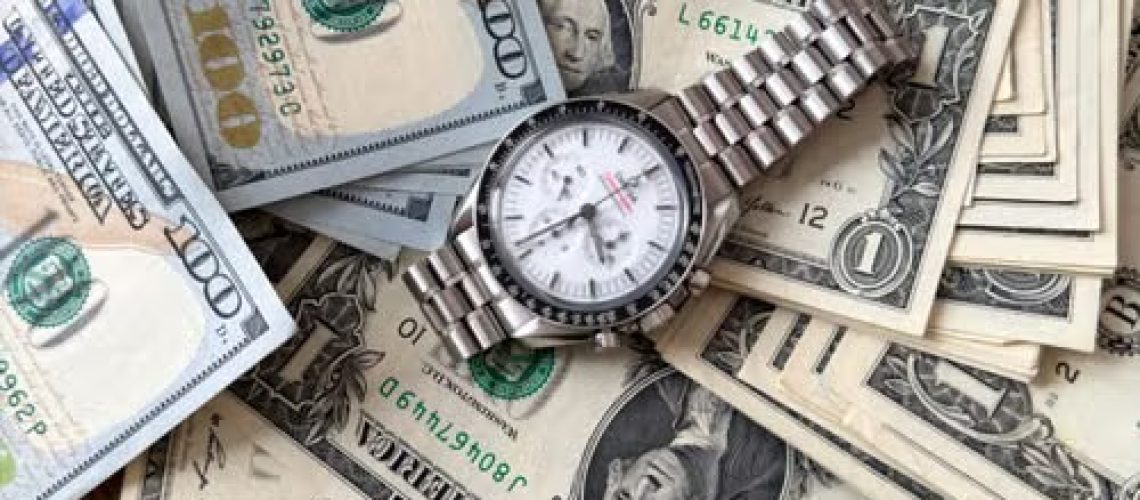

You see a watch advertised for $12,000. You own the same reference, so you contact a dealer about selling yours. The offer comes back at $9,000.
Your first thought might be: “They want to make $3,000 just for selling my watch.”
That reaction is understandable. But it leaves several questions unanswered. Will the advertised watch actually sell for $12,000? Is it comparable to yours? What will the dealer spend preparing and selling your watch? How long will the money remain tied up?
The difference between a dealer’s buying price and selling price is commonly called the spread. Understanding the watch dealer spread helps explain cash offers, trade values, retail pricing, and why two businesses might value the same watch differently.
It also helps you evaluate a deal without assuming that every dollar between the offer and the listing price becomes profit.
All numerical examples below are hypothetical. They illustrate the economics of a transaction, not typical industry margins or actual Tailored Timepieces transactions.
What Is the Spread in Watch Trading?
For this article, the realized spread means the actual selling price minus the dealer’s acquisition price, before other costs.
If a dealer buys a watch for $9,000 and sells it for $11,500, the realized spread is $2,500.
An advertised spread is different. If that watch is listed at $12,000, the difference between purchase cost and asking price is $3,000. Until a buyer pays, that amount remains a possibility, not a completed result.
This distinction matters when someone compares an offer on their watch with another dealer’s listing. An asking price shows what a seller wants. It does not, by itself, establish what a buyer has paid.
The useful comparison is between genuinely comparable watches and realistic transaction prices, with the sale terms included.
Spread, Markup, and Margin Are Different Numbers
Three terms can describe the same transaction while producing different figures.
Using the hypothetical $9,000 purchase and $11,500 sale:
|Measure |Calculation |Result |
|———————————-|————————-|——————-|
|Realized spread before other costs|$11,500 minus $9,000 |$2,500 |
|Markup on acquisition cost |$2,500 divided by $9,000 |Approximately 27.8%|
|Margin before other costs |$2,500 divided by $11,500|Approximately 21.7%|
None of these calculations establishes the business’s net profit.
For that, you need to account for the applicable preparation costs, selling expenses, overhead, and other obligations. Formal accounting treatment may classify particular expenses differently, so the table is a pricing illustration rather than a financial statement.
When someone says a dealer “makes 20%,” the next question should be: Twenty percent of what, and before which expenses?
Where the Spread Goes
A watch transaction can involve more than buying an object, taking a photograph, and forwarding a package.
Depending on the watch and the business, expenses may include inspection, necessary repairs, insured transportation, platform charges, payment processing, photography, and staff time. A dealer may also have obligations under the specific warranty or return terms provided with the sale.
Marketplace costs are a documented example. Chrono24 describes a professional dealer pricing structure with monthly packages and commissions, and directs dealers to its revenue calculator for the exact commission on a watch. There is no reason to apply one assumed fee to every dealer transaction. Source: Chrono24
Consider this hypothetical sale:
|Item |Amount |
|——————————————|——:|
|Actual selling price |$11,500|
|Watch acquisition cost |−$9,000|
|Inspection and preparation |−$350 |
|Selling and payment expenses |−$450 |
|Shipping and insurance |−$150 |
|Amount remaining before overhead and taxes|$1,550 |
The original $2,500 spread has become $1,550 before general business expenses and taxes. These invented costs are not quotes or market averages. Their purpose is to show why the spread and the final profit are different numbers.
An unusually expensive repair, additional discount, or other transaction cost would change the result again.
Why a Dealer Cannot Offer the Expected Retail Selling Price
An outright purchase requires the dealer to commit money before finding the next buyer.
If the dealer expects to sell a watch for $10,000 and pays the owner $10,000, there is nothing left to cover expenses or produce a return. Even a smooth sale would become a loss once costs were added.
A useful way to understand an offer is to work backward:
Expected resale proceeds − expected costs − allowance for uncertainty − desired business return = potential purchase offer.
This is a decision framework, not a universal formula used identically by every watch business.
The key is that an offer must make sense at the moment the dealer commits. The dealer cannot base every purchase on the best possible buyer, the highest visible listing, and the assumption that nothing will go wrong.
The seller, meanwhile, can decide whether the offered amount is worth accepting. Understanding the economics does not require accepting an offer that fails to meet your goals.
Why the Same Reference Can Receive Different Offers
A reference number is the beginning of a comparison, not the end.
Before comparing prices, examine the exact configuration, condition, included accessories, bracelet links, documented service history, and any disclosed changes or defects. A visually similar watch may not be an equivalent purchase.
Watchfinder explicitly states that it can buy watches without their box and papers, while noting that their absence can affect value. That supports treating completeness as a valuation factor, without assigning an automatic dollar premium to every set. Source: Watchfinder
You should also separate observable facts from claims that need verification. A recent service invoice documents work described on that invoice. It does not automatically establish that every component is original or that no future repair will be needed.
The better the information, the more meaningful the comparison. “Same model” is not enough to prove that two watches should receive identical offers.
Holding Time Changes the Economics
Imagine two hypothetical purchases that each produce $1,000 after direct transaction expenses.
One sells in seven days. The other takes six months.
The dollar result is the same, but the dealer’s money is unavailable for other purchases for very different lengths of time. During that period, another opportunity may appear, a buyer may negotiate harder, or the expected resale price may change.
This is why liquidity matters. Here, liquidity means the ability to convert a watch into money within a desired timeframe at an acceptable price.
A watch can be attractive, rare, and well made while still requiring patience to sell. Scarcity alone does not establish how many buyers will pay the asking price.
A dealer evaluating a slower sale may therefore require more room in the purchase price. That is an assessment of the proposed transaction, not necessarily a judgment about the watch’s quality.
There Is No Verified Universal Watch Dealer Margin
What percentage do watch dealers make?
Insufficient data to verify a universal industry percentage.
A single number would need a defined dataset, period, business model, and accounting method to mean much. An outright inventory purchase, a consignment sale, and a sourcing transaction do not have identical economics.
Even within one hypothetical business, a quick sale could justify a different target from a watch needing substantial work or an uncertain selling period.
Be cautious with claims that every dealer pays a fixed percentage below retail. Before using that claim to evaluate your offer, ask what “retail” means: original manufacturer pricing, current advertised prices, or documented completed sales?
Without that distinction, the percentage can sound precise while explaining very little.
Cash Offers and Trade Offers Need Separate Comparisons
A trade combines the sale of your watch with the purchase of another watch.
That makes the allowance on your watch only one part of the deal. The price of the replacement watch matters just as much.
Consider these hypothetical offers:
|Offer |Replacement watch price|Trade allowance|Cash difference|
|——–|———————-:|————–:|————–:|
|Dealer A|$15,000 |$10,000 |$5,000 |
|Dealer B|$13,500 |$9,000 |$4,500 |
Dealer A gives the higher trade allowance. Dealer B requires $500 less cash.
That does not automatically make Dealer B the better choice, because condition, completeness, service, and terms still need comparison. It does show why a higher allowance alone cannot establish a better transaction.
Ask for the full proposal in writing. Identify the watch being purchased, the watch being traded, the cash difference, applicable charges, and any conditions attached to the valuation.
You can then evaluate the complete exchange instead of negotiating around one appealing number.
How Consignment Changes the Arrangement
In a consignment arrangement, an owner places a watch with a dealer to sell under agreed terms, rather than receiving an immediate outright purchase payment.
The dealer’s compensation may be a commission, an agreed amount above an owner’s net payout, or another structure specified in the contract.
Here is a simple hypothetical example: A watch sells for $12,000 under an agreement providing a 10% commission and no additional deductions. The commission is $1,200, leaving $10,800 for the owner.
That arithmetic applies only to those invented terms. Actual agreements may allocate expenses differently.
Before consigning, establish the minimum acceptable proceeds, authority to discount, responsibility for repairs, insurance arrangements, withdrawal terms, and payout timing. Also establish how a return or disputed payment would be handled under the agreement.
Consignment may suit an owner willing to wait for a sale. An outright purchase may suit an owner who places greater value on receiving an agreed payment sooner. Compare the actual proposals rather than assuming one route always produces a better outcome.
Wholesale and Retail Solve Different Problems
A retail transaction places a watch with its eventual owner. A wholesale transaction places it with another business intending to resell it.
The second business needs its own room for costs and profit. That helps explain why a dealer-to-dealer offer can be below an expected retail selling price.
Suppose a dealer has already held a hypothetical watch for several months. Accepting a smaller return from another dealer might release money for a different purchase. Waiting for a retail buyer might produce more money, but that outcome remains uncertain until the sale occurs.
Neither decision can be evaluated from the advertised price alone. You need the acquisition cost, additional expenses, available alternatives, and the business’s need for cash.
For a collector, the practical lesson is that different sale channels can produce different offers because they involve different buyers and responsibilities.
Does the Dealer’s Purchase Price Determine a Fair Retail Price?
A dealer’s purchase price matters to the dealer’s financial result. It does not independently establish what you should pay.
If a seller acquires a watch unusually cheaply, that does not make every higher resale price unreasonable. If a dealer overpays, that does not obligate the next buyer to cover the mistake.
Evaluate the watch against comparable alternatives, its documented condition, what is included, and the written sale terms.
The same principle applies when selling. Your original purchase price explains your cost basis, but it does not establish what another party must pay today.
Keeping those questions separate makes negotiation more productive. You can disagree about price without needing to prove that the other person’s entire business model is wrong.
How to Evaluate a Watch Dealer’s Offer
Start by deciding what outcome matters most: immediate payment, a specific replacement watch, or a patient attempt at a higher selling price.
Then gather comparable proposals using the same description, photographs, accessories, and service documentation. Make clear whether you want a cash purchase, trade, or consignment proposal.
Ask which conditions could change an initial quote after inspection. Compare the amount you would actually receive, the expected timing, and the obligations you would retain.
For a purchase, examine what the dealer is providing beyond possession of the watch. Read the description, warranty, return provisions, and any disclosed limitations. Do not assume that every dealer supplies the same protections or performs the same checks.
A spread is not proof of good service. The dealer still needs to deliver the condition, documentation, and commitments represented in the sale.
Understanding the Spread Makes You a Better Collector
The watch business involves pricing an object, committing money, finding a buyer, and managing the costs and uncertainty between those steps.
The spread is the space in which those economics have to work. It can produce a profit, shrink after expenses, or disappear if the transaction goes badly.
For collectors, understanding that structure makes offers easier to assess. You can distinguish an asking price from a completed sale, a trade allowance from the total deal, and a promising gross difference from an actual financial result.
Whether you are buying, selling, or trading a luxury watch, compare the complete transaction. The most useful number is the amount you pay or receive for the specific watch and terms in front of you.