
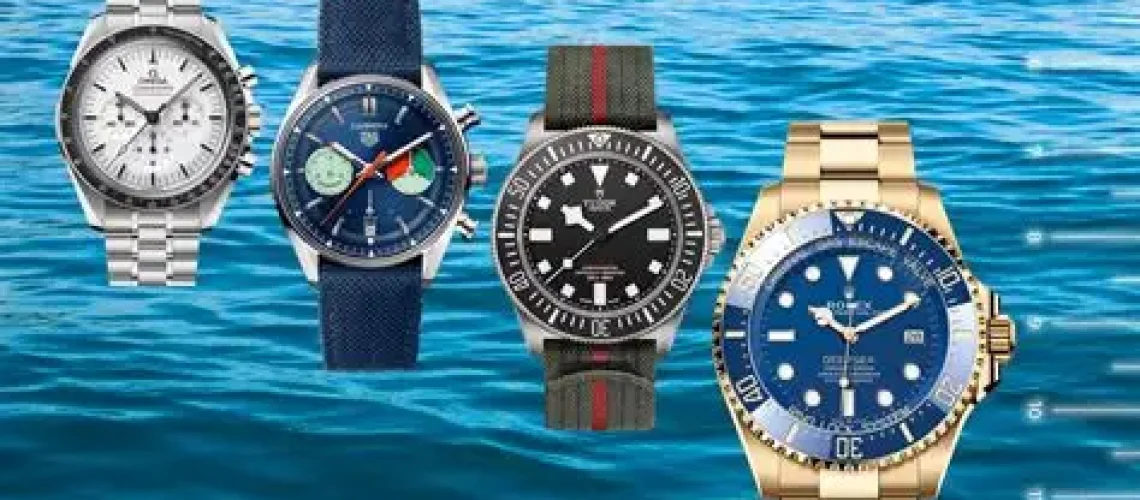

If you own a watch labeled “Water Resistant 30M,” “100M,” “200M,” or even “300M,” it is easy to assume the number tells you exactly how deep you can take it underwater.
Unfortunately, water resistance is not quite that simple.
A watch rated to 30 meters is not necessarily designed for swimming 30 meters below the surface. A 100-meter rating does not automatically mean every 100-meter-rated watch should be treated like a professional dive watch. And perhaps most importantly, no watch should be considered permanently waterproof.
That distinction is why the watch industry generally uses the term water resistant rather than waterproof.
Water resistance depends on the construction of the watch, the condition of its gaskets and seals, the crown and caseback design, previous servicing, age, temperature changes, and other factors.
For collectors, understanding those limitations can prevent one of the most expensive mistakes in watch ownership: assuming a water-resistance rating provides an absolute guarantee against water intrusion.
Here is what water resistance actually means, how watch manufacturers test it, and why even a highly rated watch should never be treated as permanently waterproof.
What Does Water Resistance Mean on a Watch?
Water resistance describes a watch’s ability to resist water entering its case under specified conditions.
Watch cases contain several potential points of entry for moisture, including:
- The crown
- Caseback
- Crystal
- Pushers
- Helium escape valves on certain dive watches
- Other case openings or seals
Manufacturers use gaskets, seals, threaded components, and case construction to help prevent water from reaching the movement.
The movement itself, however, is generally not something you want exposed to water.
Moisture entering a mechanical watch can cause serious damage. Depending on the extent of the intrusion, water may affect:
- The movement
- Dial
- Hands
- Luminous material
- Calendar components
- Internal metal surfaces
Corrosion can develop after moisture enters the case, potentially turning what initially appears to be a minor problem into a substantial repair.
Water resistance is therefore primarily about keeping the sealed environment inside the watch separated from moisture outside it.
Why Watches Are Water Resistant, Not Waterproof
The word waterproof implies that something is completely impervious to water.
That is not an appropriate assumption for a wristwatch because seals deteriorate and operating conditions vary.
A watch may successfully resist water when it leaves the manufacturer and later lose some of that protection.
Rubber and synthetic gaskets can age. Crowns can become worn. Cases can be opened for service. Components can become damaged. A crystal can suffer an impact. A caseback may not be sealed correctly after previous work.
Water resistance should therefore be viewed as a maintainable property of the watch rather than a permanent characteristic.
This is especially important with older and vintage watches.
A watch having “100M” printed on its dial does not prove that the watch remains water resistant to its original specification decades later.
The rating tells you about the watch’s intended specification, not necessarily its current physical condition.
What Does ATM Mean on a Watch?
Some watches display water resistance using ATM, or atmospheres, rather than meters.
As a general conversion:
1 ATM is approximately equivalent to 10 meters of water pressure.
Therefore:
| Rating | Approximate Static Pressure Equivalent |
|---|---|
| 3 ATM | 30 meters |
| 5 ATM | 50 meters |
| 10 ATM | 100 meters |
| 20 ATM | 200 meters |
| 30 ATM | 300 meters |
You may also see ratings expressed in bar.
One bar is approximately equal to atmospheric pressure at sea level, and watch manufacturers commonly use bar and meters together when describing water resistance.
These numbers are useful, but they are often misunderstood.
Does 30M Water Resistance Mean You Can Dive 30 Meters?
No.
This is one of the biggest misconceptions surrounding watch water resistance.
A meter rating is a pressure rating determined under controlled testing conditions. It should not automatically be interpreted as permission to descend to exactly that depth in real-world conditions.
Laboratory pressure testing and actual watch usage are different environments.
During daily wear, the watch may encounter movement, changes in temperature, aging seals, impacts, detergents, and other conditions that are not represented simply by reading the number printed on a dial or caseback.
As a result, water-resistance ratings are better understood as categories of intended use rather than literal depth limits.
Understanding Common Watch Water-Resistance Ratings
Exact recommendations can vary by manufacturer, so the manufacturer’s instructions for a specific reference should always take priority.
However, the following provides a useful general framework.
30M / 3 ATM Water Resistance
A 30-meter water-resistant watch typically provides basic protection against incidental moisture.
Think:
- Rain
- Accidental splashes
- Normal daily exposure
It should not automatically be treated as a swimming watch simply because “30M” appears on the dial.
If you want a watch specifically for swimming, a higher rating and confirmation from the manufacturer are preferable.
50M / 5 ATM Water Resistance
A 50-meter rating provides greater protection, but recommendations for swimming can differ between manufacturers and models.
Rather than assuming all 50M watches have identical capabilities, check the instructions supplied for the particular watch.
100M / 10 ATM Water Resistance
A 100-meter rating is common on sports watches and generally provides substantially more usable water resistance.
Many watches in this category are designed to accommodate swimming and recreational water exposure.
However, 100M water resistance does not automatically make a watch a professional diving instrument.
Dive watches are subject to additional design and performance considerations beyond simply having a depth rating.
200M / 20 ATM Water Resistance
A 200-meter rating is common among purpose-built dive and sports watches.
When the watch is properly maintained and the manufacturer approves the intended activity, this level of water resistance may be appropriate for significantly more demanding water use.
Again, the number alone should not replace the manufacturer’s usage instructions.
300M and Beyond
Professional and specialized dive watches frequently carry ratings of:
- 300 meters
- 500 meters
- 600 meters
- 1,000 meters
- Several thousand meters
Brands have developed increasingly extreme watches capable of resisting enormous pressure.
These specifications demonstrate impressive engineering, but even an extreme depth rating does not eliminate the need for functioning seals and proper maintenance.
A 1,000-meter-rated watch with a compromised gasket is still vulnerable to moisture.
How Is Watch Water Resistance Tested?
Watchmakers and manufacturers can test the integrity of a watch case using specialized equipment.
Testing can involve dry pressure testing or controlled wet-testing procedures.
A dry pressure tester can expose the watch to changes in air pressure and measure tiny changes in the case to determine whether it is properly sealed.
One major advantage is that the watch does not need to be submerged during the basic test.
Different manufacturers and watchmakers may use different testing procedures depending on the watch, its rated specification, and the equipment available.
For owners, the key point is simple:
The writing on the dial tells you the specification. A current pressure test gives you much more useful information about the present condition of the watch.
Water Resistance Can Decrease With Age
One of the most important things every watch owner should understand is that water resistance is not permanent.
Consider the number of components involved in maintaining a sealed watch case.
There may be gaskets around the:
- Caseback
- Crown
- Crystal
- Pushers
Those components experience aging, compression, wear, servicing, and environmental exposure.
Eventually, seals may need replacement.
That means a watch that was appropriately water resistant when new may not provide the same protection years later unless it has been properly maintained.
Why Vintage Watches Require Extra Caution
Vintage watches deserve particularly conservative treatment around water.
Imagine purchasing a Rolex, Omega, Tudor, Cartier, or another watch from the 1960s, 1970s, or 1980s.
Even if that model was originally designed for substantial water resistance, the individual watch may now contain:
- Aging seals
- Replacement parts
- Worn crown components
- Previous case refinishing
- Older crystals
- Service history that cannot be fully verified
That does not necessarily make the watch defective.
It simply means you should not assume that a decades-old watch performs exactly as it did when it left the factory.
For collectors, preserving an original dial may be far more important than discovering whether a 50-year-old watch can still survive a trip into the ocean.
Water damage to a replaceable modern component is frustrating.
Water damage to an irreplaceable vintage dial can permanently alter the value and collectibility of a watch.
Can You Shower With a Water-Resistant Watch?
Even when a watch has substantial water resistance, showering with it is often unnecessary.
There are several reasons to be cautious.
A shower can expose the watch to:
- Soap
- Shampoo
- Hot water
- Temperature changes
- Repeated moisture exposure
Unless the manufacturer specifically recommends otherwise, there is little benefit to routinely exposing an expensive watch to those conditions.
Taking the watch off before showering is simple risk reduction.
Are Screw-Down Crowns More Water Resistant?
A screw-down crown is commonly used on sports and dive watches because it can help create a secure seal and reduce the possibility of the crown being unintentionally manipulated.
Rolex’s Oyster case architecture is one of the most famous examples of using threaded components and sealing systems as part of a water-resistant watch case.
Numerous other manufacturers use similar concepts.
However, a screw-down crown does not automatically guarantee that a watch is waterproof.
The crown and its associated seals must still be in appropriate condition.
It is also important to make sure the crown is properly secured before water exposure.
Never Operate the Crown Underwater
As a general rule, avoid manipulating a conventional crown or chronograph pushers underwater unless the manufacturer specifically designed the watch to permit it.
Pulling or operating components may affect the sealing system.
This means you should avoid underwater activities such as:
- Setting the time
- Changing the date
- Winding through the crown
- Starting chronograph pushers not designed for underwater operation
Certain specialized watches are engineered differently, so manufacturer-specific instructions should always override general guidance.
What Happens If Water Gets Inside Your Watch?
One of the most obvious warning signs of moisture intrusion is condensation underneath the crystal.
If you notice fogging or visible moisture inside your watch, do not ignore it.
Water can begin affecting metal components and delicate dial surfaces.
The appropriate response is to have the watch examined by a qualified watchmaker or authorized service provider as soon as practical.
Do not assume that the condensation will disappear harmlessly.
The visible moisture may evaporate while water or humidity remains trapped inside the case.
How Often Should You Pressure-Test a Watch?
There is no single testing schedule appropriate for every watch.
The correct interval depends on:
- Manufacturer recommendations
- Intended use
- Watch age
- Service history
- Recent repairs
- Exposure to water
- Condition of the watch
If you regularly swim or dive with an expensive watch, periodic testing becomes particularly valuable.
A pressure test can provide far more confidence than simply relying on the depth rating engraved on the watch.
Testing is also sensible after the case has been opened or when there is uncertainty regarding the watch’s service history.
Does Servicing Restore Water Resistance?
Potentially, but it should never be assumed.
During proper servicing, a watchmaker may inspect and replace seals and test the assembled watch for water resistance.
Whether the watch can be restored to its original specification depends on its condition, components, construction, and the work performed.
This becomes especially relevant with vintage watches where maintaining originality and restoring maximum water resistance can sometimes represent different priorities.
Ask the watchmaker whether the watch was pressure tested after service and what test it passed.
That information is more useful than assuming servicing automatically guarantees water resistance.
Water Resistance vs. Dive Watch Certification
Another important distinction is that water resistance and being a dive watch are not synonymous.
A watch can have substantial water resistance without necessarily meeting all of the requirements associated with a standardized diver’s watch.
The international ISO 6425 standard covers diver’s watches and includes requirements beyond a simple depth rating.
Therefore, seeing “200M” on a watch should not automatically be interpreted as evidence that it satisfies every technical requirement applicable to a certified diver’s watch.
Why Collectors Sometimes Avoid Water Completely
You may occasionally encounter someone wearing a legendary dive watch who refuses to put it anywhere near a swimming pool.
That might sound ridiculous.
In some cases, it is perfectly rational.
Imagine owning a vintage dive watch with:
- An original dial
- Original tritium lume
- Rare hands
- A valuable bezel
- Significant historical importance
Technically proving whether the watch can survive underwater may provide virtually no benefit to the owner.
The downside, however, could be enormous.
This illustrates one of the differences between watch capability and collector behavior.
A watch may have originally been built as a tool, but decades later it may also be a historical collectible.
The Most Important Rule: Never Assume
If you remember only one thing about watch water resistance, remember this:
A depth rating does not guarantee the current condition of an individual watch.
Before exposing a valuable watch to water, consider three questions:
- What was the watch designed to withstand?
- What does the manufacturer recommend?
- Has this particular watch recently passed an appropriate pressure test?
The third question is especially important.
A specification printed on a dial may be decades old.
A pressure test tells you something about the watch sitting on your wrist today.
Frequently Asked Questions About Watch Water Resistance
Is a water-resistant watch waterproof?
No watch should be regarded as permanently waterproof. Water resistance depends on the integrity of the case, seals, crown, crystal, and other components.
Can I swim with a 30M water-resistant watch?
You should not assume that a 30M rating means the watch is suitable for swimming. Check the manufacturer’s recommendations for the specific watch.
Can I swim with a 100M watch?
Many watches rated to 100 meters are designed for swimming and recreational water use, but the manufacturer’s instructions and the current condition of the watch should determine how it is used.
Does a screw-down crown make a watch waterproof?
No. A screw-down crown can contribute to water resistance, but the seals and other parts of the case must also be functioning correctly.
Can vintage watches still be water resistant?
Yes, some vintage watches can still pass pressure testing. However, this should be verified rather than assumed based on the watch’s original specification.
What should I do if my watch fogs up?
Condensation beneath the crystal can indicate moisture inside the case. Have the watch evaluated promptly by a qualified watchmaker or service center.
Should I pressure-test my watch before swimming?
For a valuable watch, particularly one with an uncertain service history, confirming current water resistance before regular water exposure is a sensible precaution.
Final Thoughts: Water Resistant Does Not Mean Waterproof
Water resistance is one of the most useful and misunderstood specifications in watch collecting.
A 100M, 200M, or 300M designation is not a magical shield surrounding the movement. It describes the engineering and tested capability of a watch under defined conditions.
Real watches age.
Gaskets deteriorate. Crowns wear. Cases are opened. Crystals are replaced. Watches are dropped, repaired, polished, serviced, and passed from one collector to another.
That is why “water resistant” is a much more accurate concept than “waterproof.”
For a modern sports watch that is correctly maintained and tested, water can be part of the experience the watch was designed to handle.
For an important vintage piece, avoiding water altogether may be the smarter choice.
Either way, do not judge the current water resistance of a watch solely by the number printed on its dial.
Know the specification. Follow the manufacturer’s guidance. Maintain the seals. And when water exposure matters, have the watch pressure tested.
That approach is far less expensive than learning about water resistance after moisture has already made its way inside your watch.